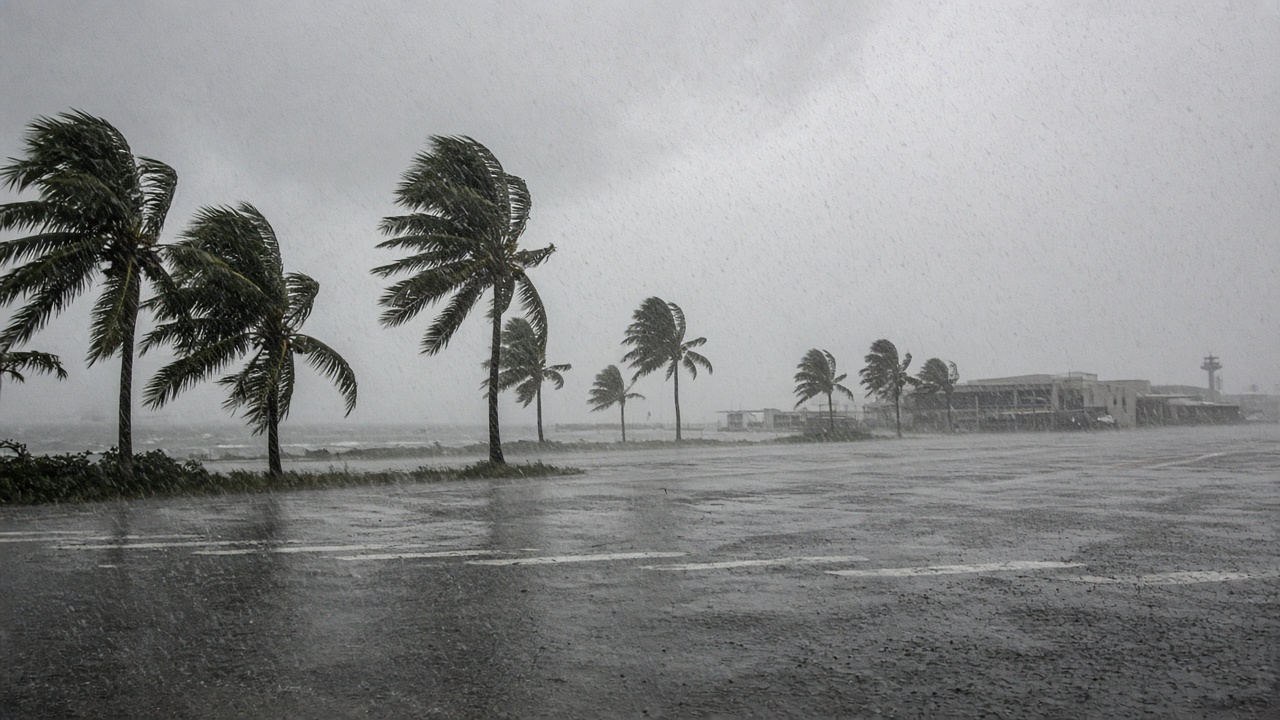
Warm, damp air wrapping around Typhoon In-fa dumped 138.5 millimeters of rain on Niijima Airport in just six hours through midnight Wednesday, Japan’s public broadcaster NHK reported, as the Japan Meteorological Agency issued Level 4 landslide warnings for Niijima Village and Minamiboso City in Chiba Prefecture.
Storm track south of Honshu
In-fa was moving north off Japan’s southern coast at about 15 kilometers per hour on Wednesday evening with a central pressure of 970 hectopascals, NHK said. Sustained winds near the center reached 126 kilometers per hour, with gusts to 180 kilometers per hour, keeping the storm’s core over open water but pumping moisture into the Kanto region and the Izu island chain.
The Hong Kong Observatory’s bulletin early Thursday placed the typhoon east-northeast of Hong Kong and forecast it to accelerate northeast across seas south of Japan before transitioning into an extratropical system. For residents in the Tokyo metro area, the immediate risk is not a direct landfall but the plume of unstable air ahead of the circulation.
Where the heaviest rain falls next
Agency forecasters warned that atmospheric conditions will remain unstable through Thursday, with extreme downpours exceeding 50 millimeters per hour possible around noon on the Izu Islands and during the morning in Kanto. Twenty-four-hour totals could reach 180 millimeters in the Izu chain, 130 millimeters in southern Kanto and 120 millimeters in northern Kanto, NHK reported.
Coastal winds are expected to strengthen, and officials urged vigilance for high waves, lightning and localized tornadoes. Level 4 information corresponds to the cabinet office’s “evacuate everyone from dangerous locations” guidance even before a municipality publishes a formal order, according to JMA explanatory materials.
Observatory bulletins list In-fa at typhoon strength with sustained winds near 120 kilometers per hour as it turns northeast, reducing direct wind threat to Okinawa but keeping moisture feeds pointed at Honshu.
What island officials are telling residents
On Niijima, the six-hour rainfall total exceeded what many drainage systems are designed to handle in a single burst, raising the risk of mudslides on steep volcanic slopes. In Minamiboso, saturated ground along the Pacific coast faces similar threats as bands rotate ashore.
Transport links to the Izu Islands can be suspended quickly when crosswinds exceed airport limits, and ferry operators typically tighten schedules when typhoon advisories overlap with high-wave warnings. Residents are advised to finish evacuation before roads flood, using hazard maps rather than waiting for sirens alone. In-fa is the season’s latest reminder that a typhoon hundreds of kilometers offshore can still rewrite a commuter’s Thursday.
Tokyo’s metropolitan government said it had not ordered wide closures but told riverfront parks to remove rental bikes and temporary signage that could become debris. Chiba Prefecture opened an overnight hotline for landslide reports in Minamiboso as soil sensors began registering saturation spikes.