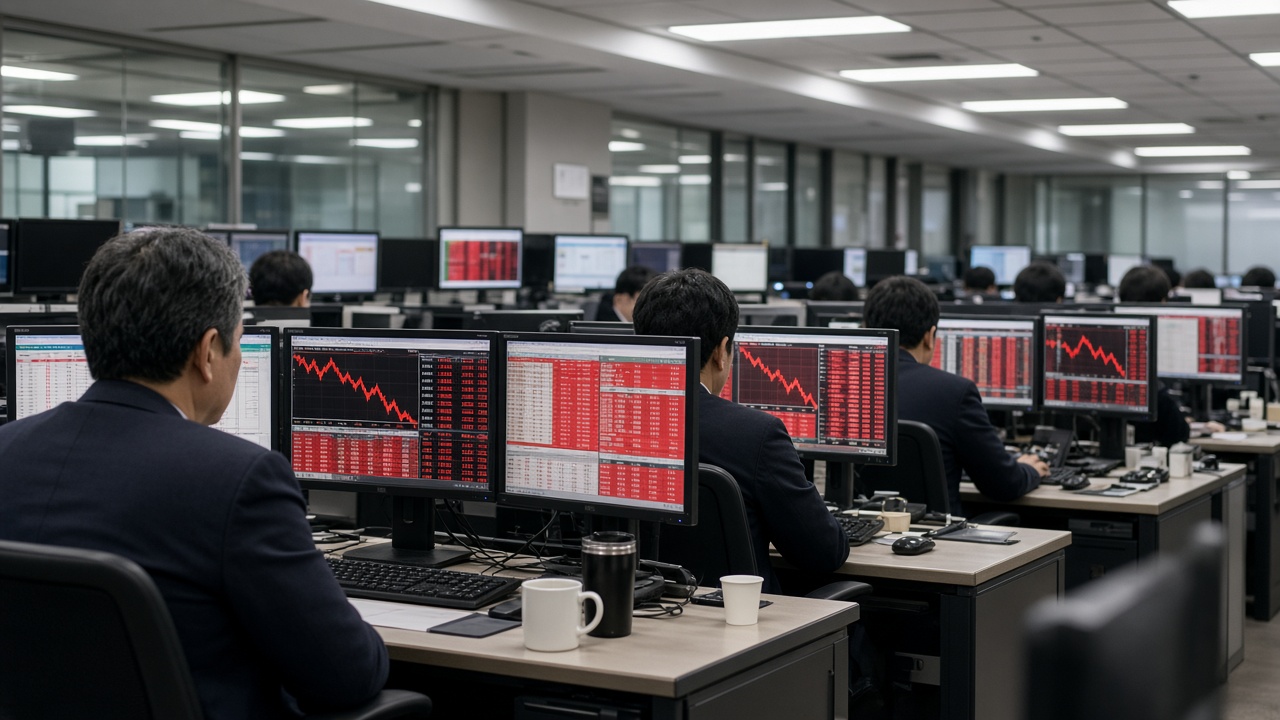
Foreign investors sold about 3.4 trillion won in Kospi cash equities on 5 November, dragging the benchmark down 300 points, or 5.28 percent, to 5,383.80 as Democratic gains in U.S. midterm elections revived fears that data-center power and water regulation would slow AI infrastructure spending and memory demand.
Session mechanics
Samsung Electronics fell 7.57 percent and SK hynix 9.46 percent, pulling the Kospi to a seven-month low. The Kosdaq slid 5.11 percent to 678.41, losing the 700 handle. Sell-sidecars triggered on both markets as program sell orders stacked, Korea Exchange data show.
SBS reported foreigners unloaded roughly 6 trillion won over two sessions, with the two memory giants accounting for nearly 80 percent of that flow. Desk read: liquidity-heavy macro de-risking rather than a single earnings miss.
Washington narrative in Seoul
Donga Ilbo and JoongAng coverage linked the rout to a “blue tsunami” storyline: U.S. Democrats who campaigned on tightening hyperscaler energy use raised the prospect of slower GPU and DRAM deployments. Memory names that rallied on AI build-outs reversed, while some U.S. cloud names still rose in New York.
Kosdaq equipment names—Jusung Engineering, Simtek and peers—fell double digits. Mirae Asset and Samsung Securities notes cautioned grid-saving bills remain drafts, not law, but funds sold anyway.
Partial offsets
Hyundai Motor and Kia rose about 3 and 5 percent on hopes tariff pressure could ease under a divided Congress, SBS said. Defense and refining shares slipped on parallel Middle East de-escalation narratives.
Program trading halts paused automated selling twice on the Kospi, giving human desks a breather, but foreign futures hedges kept pressure into the close.
Checkpoints ahead
Strategists listed three watches: U.S. Senate committee action on data-center bills, November DRAM export data from Korea Customs, and Bank of Korea language on financial stability if margin debt spikes.
Until then, 5,383.80 anchors Seoul risk committees—a close that priced regulation fear faster than fabs could publish counters.
Derivatives and hedging
Kospi 200 mini futures in Singapore finished lower in tandem, widening basis gaps brokers use to hedge ADR portfolios. Won non-deliverable forward curves did not show panic dollar demand, suggesting the equity move was sector-specific rather than a broad Korea risk exit. Options desks reported elevated put skew on memory names into the November monthly expiry.
Sector breadth
Beyond memory, Kosdaq biotech and game names participated in the decline as foreign ETFs cut Korea exposure wholesale rather than stock-picking. Battery material issuers with U.S. plant plans fell on the same data-center narrative even though their revenue ties are less direct than DRAM exporters.
Credit and margin
Bank of Korea officials did not issue an emergency statement, but securities finance desks reported higher intraday margin calls on retail accounts concentrated in Samsung and SK hynix. Credit default swap spreads on Korean sovereign debt moved only slightly, suggesting the selloff remained an equity beta event rather than a country-risk repricing.
Flow detail
Passive funds tracking MSCI Korea saw redemption-driven sells overlap with macro hedge cuts, amplifying the foreign outflow figure. Domestic pension rebalancing schedules were largely unchanged, suggesting the session was driven by offshore discretionary accounts rather than structural domestic sellers.
Options desks reported elevated put skew on memory names into the November monthly expiry while won NDF curves showed no panic dollar demand.
Exchange data showed program sell halts twice paused automated flows, yet human desks still faced net foreign selling into the closing auction as ADR hedges rolled.
Desk strategists said Friday’s session would test whether memory buyers emerge at sub-5,400 Kospi levels or if macro funds keep cutting Korea beta until U.S. committee calendars clarify data-center language.
Korea Exchange turnover rose versus the prior session, indicating active repositioning rather than a liquidity vacuum.
Foreign broker axes summarized the day as regulation headline risk rather than earnings downgrades from Korean issuers themselves.