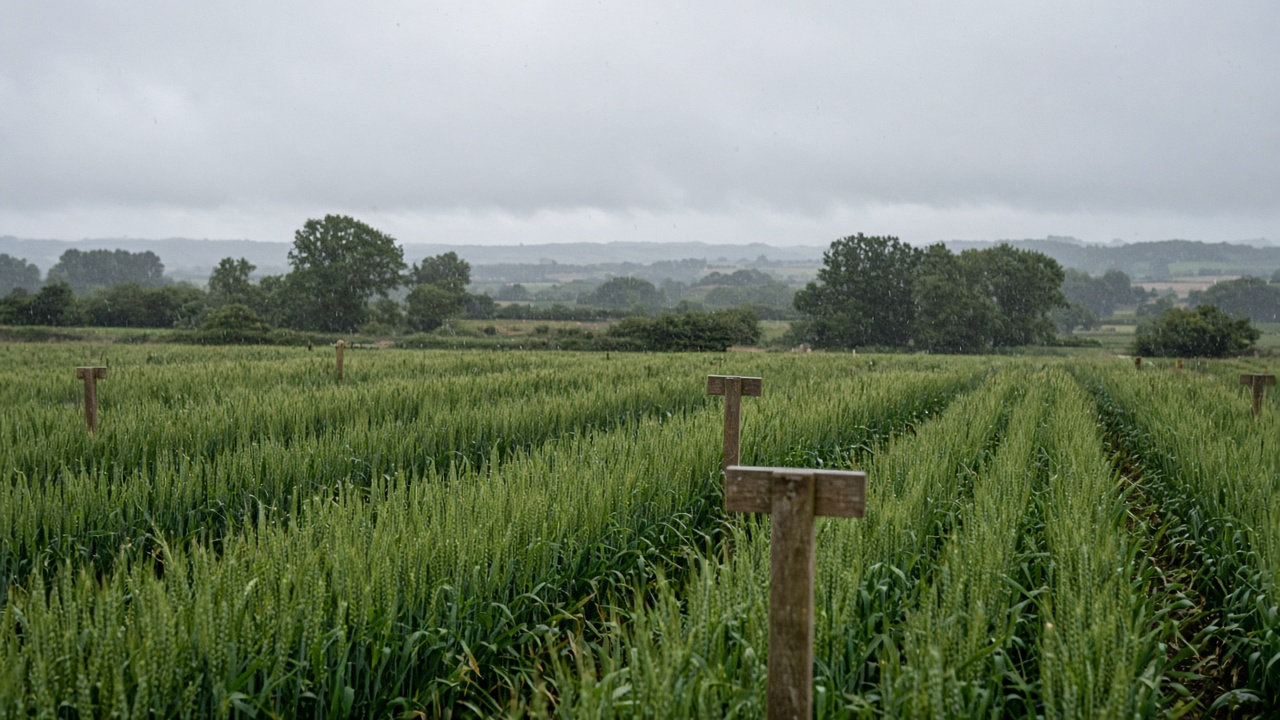
Rothamsted Research said Friday that multi-year winter wheat trials recorded measurable yield declines when scientists imposed rainfall regimes based on Met Office projections for southern England in the 2050s, underscoring how climate volatility could pressure UK food security even before summer heat peaks arrive.
The Long Field experiment, a successor to plots farmed since the nineteenth century, irrigated sections to mimic wetter winters with longer dry spells in late spring. Grain weights fell between 8% and 12% compared with control plots receiving historical averages, despite identical fertiliser applications.
Method and limits
Researchers stressed they simulated rainfall timing, not atmospheric carbon dioxide enrichment, meaning results understate potential stress once combined warming effects are included. Still, the trial offers policymakers concrete numbers for adaptive breeding programmes funded through UK Research and Innovation. Seeds bred for drought resistance did not fully compensate when root zones saturated in February then cracked in May.
Farm economics
National Farmers’ Union leaders have cited unpredictable moisture as a bigger near-term headache than headline temperature rise. Feed wheat prices on futures markets already incorporate Black Sea supply swings; domestic shortfalls would raise costs for pig and poultry integrators concentrated in eastern England. Environment Department officials monitoring food resilience dashboards will treat the trial as input for the forthcoming land-use framework.
Breeding and policy responses
Rothamsted partners with commercial seed houses to genotype plants that tolerate oscillating moisture. Public funding may accelerate if the Budget protects science budgets. Separately, catchment groups debate reservoir expansion versus softer demand measures. Trial data suggest drainage investment alone cannot offset rainfall concentration without soil organic matter improvements.
Why this matters beyond agriculture
Supermarkets marketing British flour and malt quote domestic sourcing in sustainability reports. Any persistent yield gap risks more imports, increasing embedded transport emissions and forex exposure for sterling-denominated retailers. Climate adaptation is therefore a trade story as much as a rural affairs column.
Next research steps
The institute plans to combine rainfall tweaks with elevated CO2 chambers next season. Results will feed into advisory tools for agronomists using precision moisture probes. Field teams will also compare rotation sequences—winter oilseed break crops followed by wheat versus continuous wheat—to see whether break crops cushion moisture shocks. Early subsamples suggest rotations with cover crops retain marginally more soil water, though the effect did not fully offset the simulated rainfall shift.
Until peer-reviewed papers land, policymakers have an early, plot-level warning that familiar wheat varieties may not handle the precipitation pattern Britain’s weather models foresee within a generation, and that adaptation funding may need to move faster than variety release cycles.