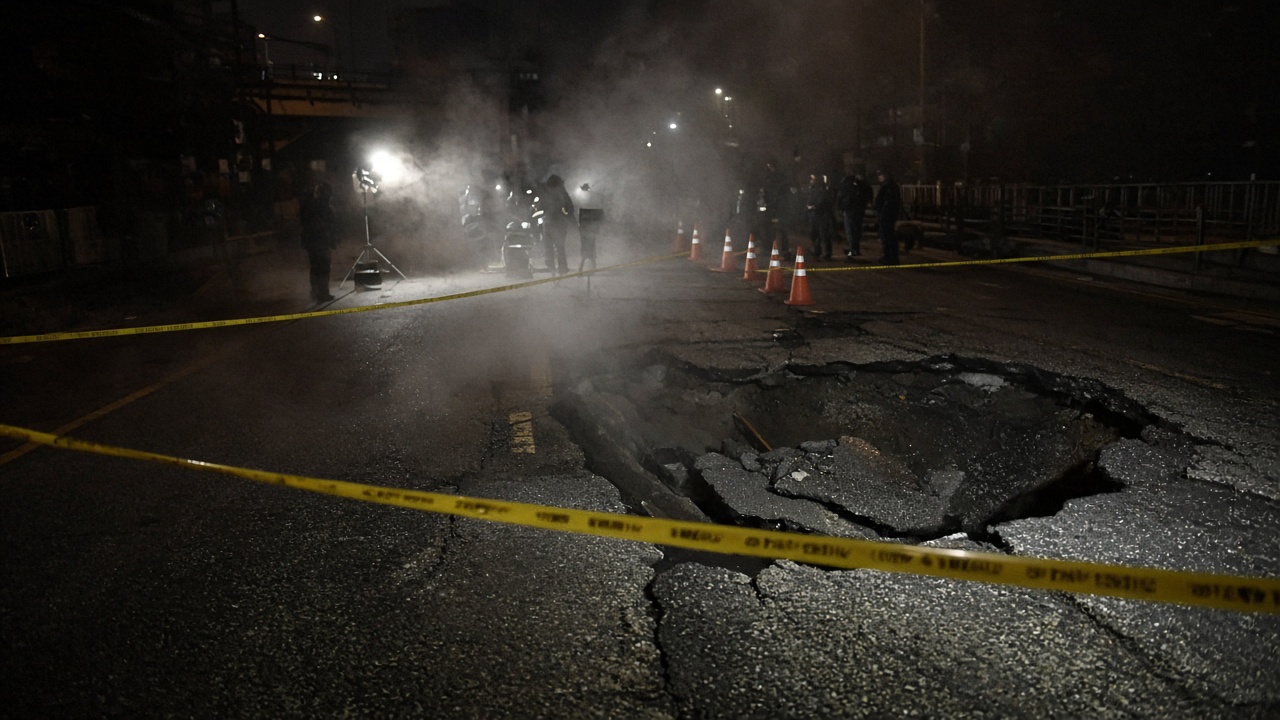
A rupture in a buried heat-transport pipe on a Magok-dong roadside in western Seoul sent near-boiling water into the street Friday night, collapsing pavement, toppling a traffic signal, and leaving roughly 8,965 households without heating and hot water for much of the night.
Hours later, a man in his 40s walking past the repair zone fell into the scalded pit and suffered second- and third-degree burns across more than 60 percent of his body. Fire officials said he remained in critical condition in intensive care on Saturday, the most serious casualty so far in an accident that has renewed scrutiny of aging district-energy lines around new apartment clusters.
Timeline of the break
Gangseo District officials said the pipe failed at about 8:18 p.m. on November 6 near a large apartment complex. Steam vented along the roadway, the surface subsided, and one signal pole tipped over. Seoul Energy Corporation, which operates the thermal network, dispatched crews immediately, but the repair lasted until about 8:45 a.m. Saturday—nearly 11 hours after the initial rupture.
District heating water in Seoul’s combined heat-and-power systems often travels at 100 to 110 degrees Celsius. When a pressurized line splits under a car lane, the escaping fluid can carve out voids beneath asphalt within minutes. That is what firefighters believe happened here: a hidden cavity capped by a thin crust of road surface.
The pedestrian injury
At roughly 1 a.m. Saturday, dispatchers received a report of a burn victim at the cordoned site. The man, identified in local coverage only by the surname A, had crossed near yellow control tape and dropped into the hole while emergency workers were still stabilizing the line. Surveillance footage aired by SBS shows him stepping toward a crosswalk before the pavement gives way.
Medics transported him to a hospital with deep burns covering most of his body. A Seoul Energy Corporation staff member who stepped into pooled hot water while inspecting the crater received lesser injuries and was treated and released, according to Yonhap News Agency.
Service disruption
The outage hit 8,965 households connected to the Magok loop—just shy of the 9,000-home figure cited in early alerts. Residents told broadcasters they spent a frigid night without radiators or hot taps while outdoor temperatures hovered near freezing. Gangseo District set up bottled-water distribution and kept a hotline open for elderly tenants in high-rise blocks.
Seoul Energy Corporation said flow was restored after welding a replacement section overnight. Investigators plan to test pipe-wall thickness and review maintenance records to see whether corrosion or ground settlement triggered the split.
Policy context
Magok is one of Seoul’s newest office-and-apartment districts, but much of its thermal infrastructure was laid during the previous decade’s building boom. City auditors have warned repeatedly that underground utility corridors around Magok and nearby Gangseo neighborhoods carry higher failure risk when contractors stack multiple services in narrow trenches.
Officials promised a joint review with the Ministry of Trade, Industry and Energy on inspection cycles for district-heating suppliers. For now, police have taped off the intersection while Seoul Energy Corporation and Gangseo District compile a technical report pending metallurgical results.
What residents face
With supply restored, landlords are checking in-unit heat exchangers for air locks caused by the sudden pressure drop. The burned pedestrian’s prognosis will likely dominate weekend headlines, but housing advocates say the overnight cutoff also exposed how dependent high-rise neighborhoods are on a single thermal artery. Until investigators explain why this segment failed, Magok tenants are being asked to report any warm spots or steam near manholes immediately.