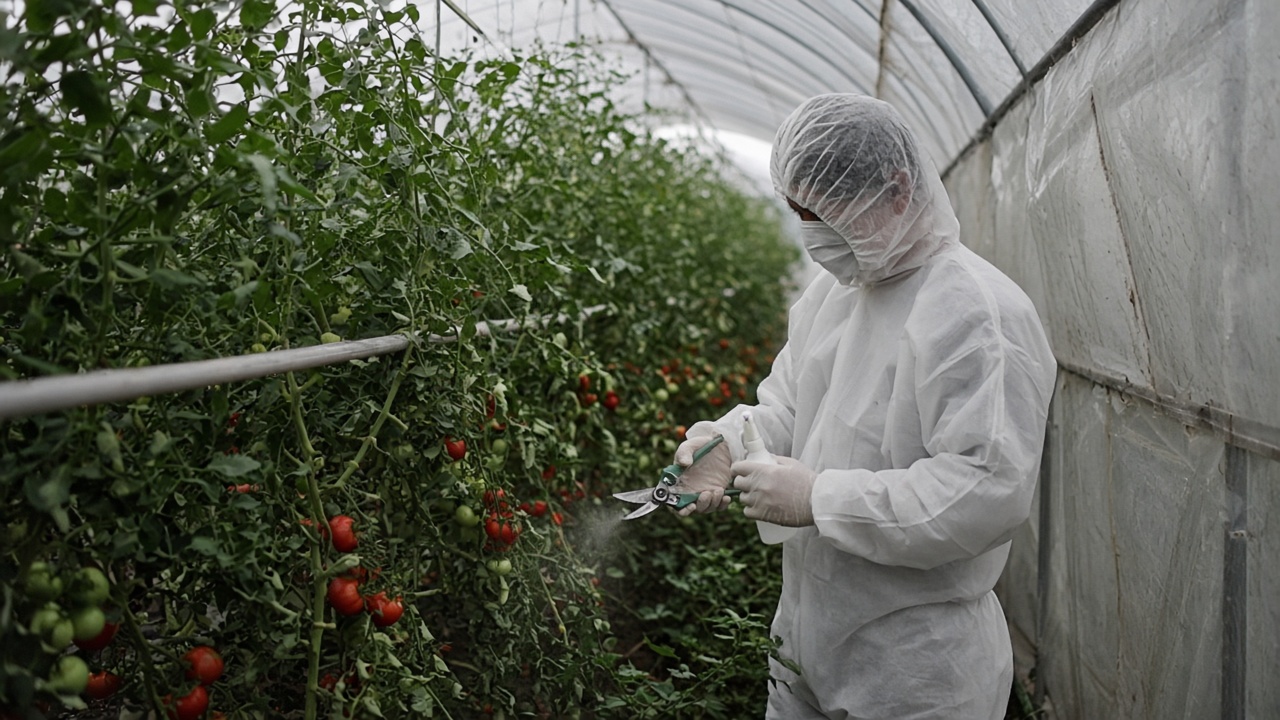
South Korea’s quarantine-listed tomato brown rugose fruit virus has reached six greenhouse tomato farms in Busan’s Gangseo district, the city’s Agricultural Technology Center said Sunday. Two additional farms are still undergoing PCR testing, and officials urged growers to treat even glove or shoe contact as a transmission risk because no chemical cure exists.
What authorities confirmed
The pathogen, known as ToBRFV, attacks tomatoes, bell peppers and chili peppers. Busan officials said positive results have so far come from six hydroponic operations that supply the region’s well-known “jjolmyeon” salty tomato varieties. The center asked farmers to report suspected symptoms by phone rather than visiting in person, warning that outsiders checking sick plants could spread infection on clothing or tools.
The national Animal and Plant Quarantine Agency first recorded domestic ToBRFV on Oct. 20 in Jeongeup, North Jeolla Province, according to YTN reporting. Cases have since appeared in Buyeo and Nonsan in South Chungcheong Province, and provincial authorities there said Saturday that infections were confirmed at 65 farms covering 43.1 hectares.
Why the virus is so hard to control
Infected tomatoes can show brown spots, wrinkled skin and uneven ripening, while leaves may develop mosaic patterns and narrow, needle-like growth. Stems and flower sepals can necrotize, causing fruit to drop early. Yield losses of 30 to 70 percent have been documented internationally, and Busan officials repeated that range in Sunday briefings.
The virus does not harm humans or livestock, and produce remains safe to eat. The practical risk is economic: without approved pesticides, containment depends on blocking outside entry, disinfecting shears and crates, and destroying infected plants under national guidelines, often by incineration.
How Busan is responding
On Nov. 5 the center ran an emergency online training session for hydroponic growers and interested farms, reaching 46 operations in a session officials said could scale to about 100 participants when soil-grown tomato farms were included. Director Park Mi-jin said farms must block visitors and maintain strict hygiene because self-policing is the only way to keep the virus out of clean greenhouses.
Growers with symptom questions can call the technical agriculture team at 051-970-3721 through 3727. Officials said suspected cases should be photographed and reported remotely so staff can order genetic PCR tests instead of on-site inspections that might carry spores inward.
What the national pattern shows
ToBRFV has been reported in more than 50 countries, and South Korea’s first detection last month triggered nationwide sampling. Busan’s Gangseo belt is a high-income tomato cluster, with city data citing farm income roughly 80 percent above the national average for the crop, which raises the stakes for any localized shutdown.
Because ToBRFV symptoms resemble pepino mosaic virus and other diseases, experts say visual diagnosis is unreliable. That uncertainty is why Busan is pushing PCR confirmation before growers rip out entire rows.
What happens next
PCR results for the two outstanding Busan farms are pending. Infected sites must isolate and destroy plants and debris under Animal and Plant Quarantine Agency rules, and neighboring farms are advised to halt cross-visits entirely. National officials have not announced new interstate movement bans Sunday, but Busan’s warnings suggest enforcement will focus on voluntary lockdowns backed by testing.