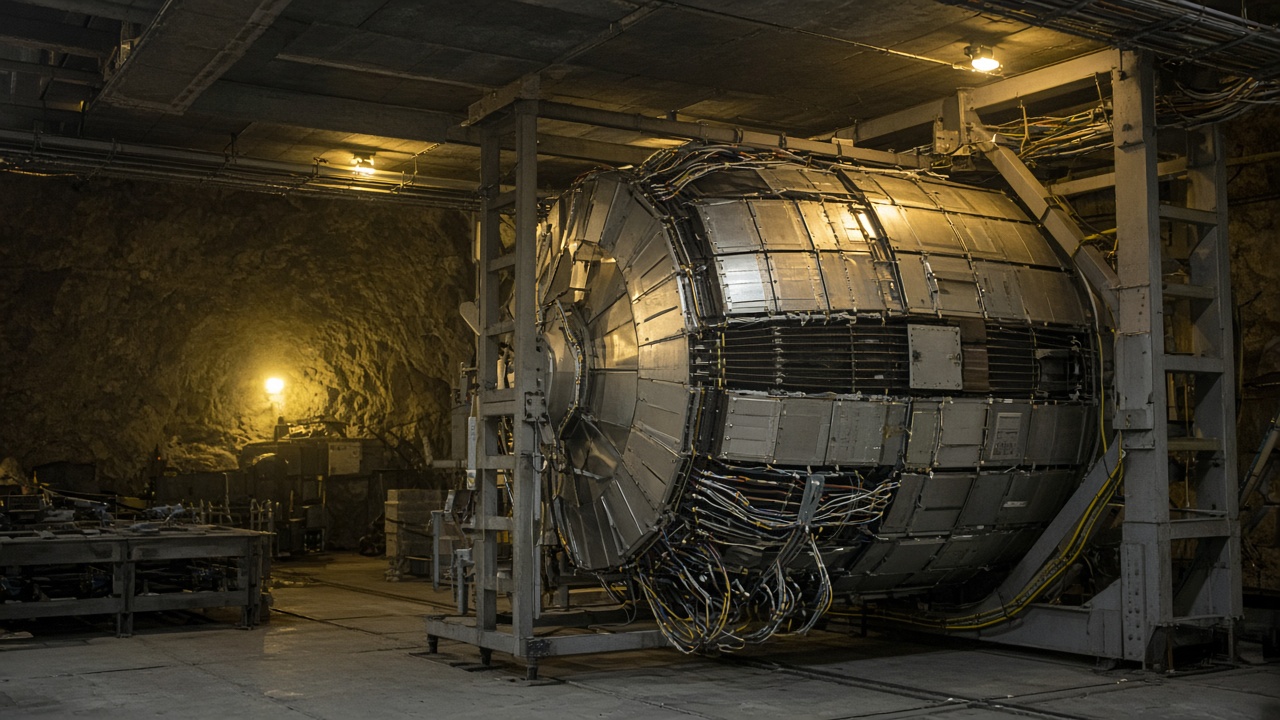
Oxford physicists working on CERN's Large Hadron Collider beauty experiment reported first evidence of an ultra-rare decay in which a beauty particle transforms into two muons, a result posted on 3 November with support from the Science and Technology Facilities Council.
The decay, written as Bd → μμ in shorthand, is predicted by the Standard Model to occur roughly once in every ten billion beauty mesons. LHCb's upgraded detector, collecting collisions at up to five times its earlier rate since 2024, gave researchers enough events to see a signal at 3.2 sigma—strong enough for "first evidence" in particle-physics convention but short of the five-sigma discovery threshold.
Why the decay matters
Beauty quarks are unstable hadrons produced when the LHC smashes protons together at energies that recreate conditions fractions of a second after the Big Bang. When they decay into muons, the pattern tests whether unknown particles influence transitions the Standard Model already calculates. Deviations could point toward new physics; agreement tightens constraints on supersymmetry and other extensions theorists have hunted for decades.
The Oxford group contributed to machine-learning classifiers that separate genuine muon pairs from the vast background of random debris in the detector. The team also released updated measurements of a related decay, Bs → μμ, first observed by LHCb in 2015, improving precision by combining 2024–2025 data with archival runs from 2011–2018.
UK funding context
STFC pays Britain's subscription to CERN and funds university groups analysing LHC data. The result lands amid domestic debate over UK Research and Innovation cuts to particle-physics upgrades, including a planned £150 million enhancement to LHCb that partners hope will multiply rare decays tenfold. Scientists argue that withdrawing would cede leadership just as the upgraded detector starts producing textbook results.
BBC science coverage this week linked the measurement to the "zeptoverse"—scales billions of times smaller than an atom—where interactions might couple to dark matter. That popular framing oversimplifies the maths but captures public interest in why governments fund ring colliders.
What happens next at Geneva
Researchers will fold the new evidence into global fits of the Standard Model. If the signal strengthens toward five sigma in the next data-taking window, textbooks will add another checked box; if it fades, systemic errors in background modeling will be the likely culprit. Either outcome advances knowledge. For UK taxpayers, the immediate question is whether STFC keeps paying for the hardware that makes such measurements possible on British time zones.
Graduate students in Oxford and Cambridge who contributed classifier code will rotate back to teaching this week while collaborators at CERN analyse the next collision batch. Public lectures scheduled for November on particle physics aim to translate sigma levels into plain English for donors who fund summer schools. The politics of science funding rarely share a calendar with Remembrance Sunday, but both ask what Britain wants to remember and what it still intends to build.