Hon Hai Precision Industry, known globally as Foxconn, reported record October consolidated revenue of NT$1.3 trillion (US$39.47 billion), a 45.73 percent year-on-year jump that keeps AI rack assembly at the center of Taiwan’s industrial story even as the TAIEX trades in bear-market territory.
The company filed the unaudited figures Thursday evening, two days before the broader market’s worst weekly slide in years. Revenue rose 12.66 percent from September, reflecting sustained cloud and networking shipments even as investors question whether hyperscaler capital spending will earn adequate returns.
Why the print matters now
Hon Hai does not guide numerically, so monthly revenue has become a high-frequency proxy for AI hardware demand. October’s strength suggests that physical builds continued while U.S. mega-cap technology shares sold off on data-center ROI fears. Traders will nevertheless demand margin commentary on Wednesday’s quarterly call: component costs, customer mix, and any sign that orders push into 2027 without new purchase orders.
Contract manufacturers are caught between two narratives. Export statistics through September still show explosive growth in information and communication products, and the Ministry of Finance expects another strong October customs print on Monday afternoon. Equity investors, meanwhile, punish any hint that cloud budgets pause—even when factory lines stay busy.
Product mix and capacity
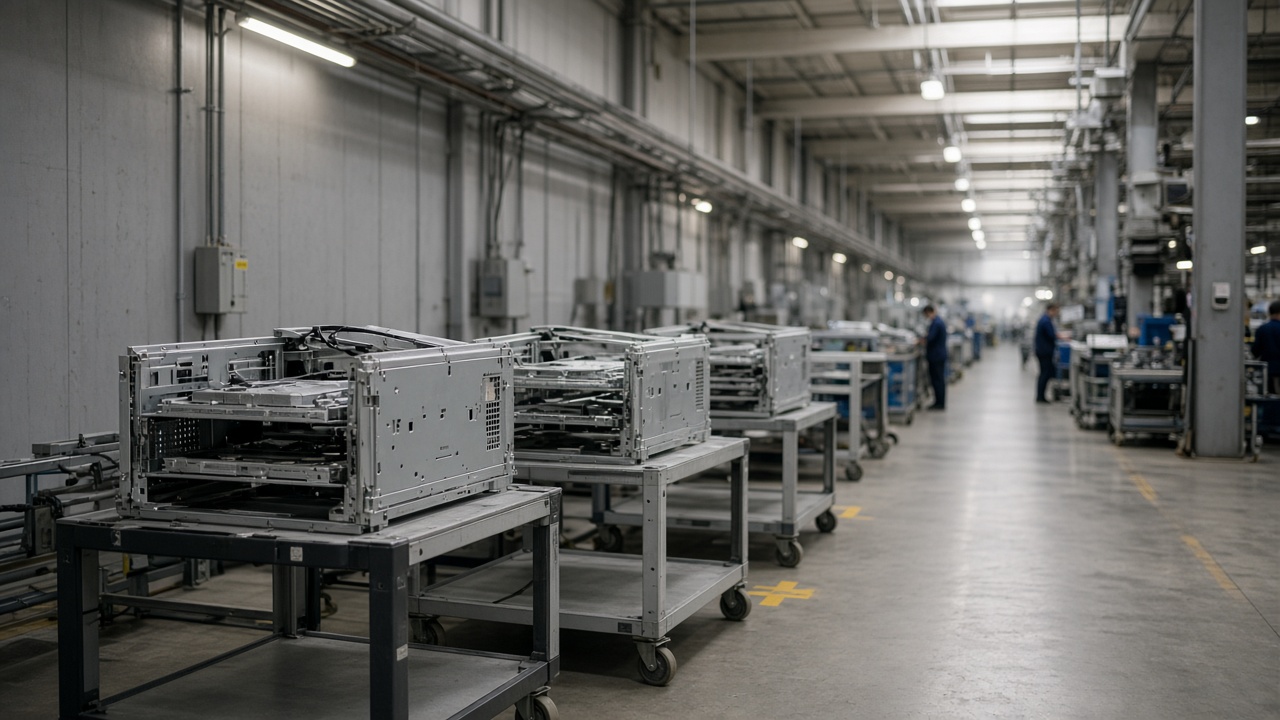
People familiar with the supply chain said rack integration and GPU module assembly accounted for most of the month-on-month increase, while consumer electronics remained seasonally soft ahead of year-end handset launches. Hon Hai has been expanding North American server capacity to satisfy customers diversifying beyond China, and October revenue likely includes early shipments from those lines.
Competitors Quanta Computer and Wistron report their own monthly sales this week. If they corroborate Hon Hai’s trajectory, bears will argue that fundamentals diverge from prices; if they soften, the market may read AI demand as peaking simultaneously across builders.
Investor setup
Hon Hai’s Taiwan-listed shares have not been immune to the rout, sliding with the electronics subindex even as revenue scales. That disconnect sets up a tense earnings call: management must explain why cash flow and capex plans remain intact while customers’ market caps shrink.
For Taipei readers, Hon Hai’s print is a reminder that island exporters can post record sales while local portfolios bleed. Whether Monday’s stabilization bid or Wednesday’s conference changes that mood depends less on October’s trillion-dollar headline than on what executives say about November order visibility—and whether buyers believe them.
Geographic split
Revenue growth continues to reflect geographic diversification. North American server shipments rose with new capacity in Mexico and the U.S. Midwest, while China consumption remained subdued relative to pre-pandemic handset cycles. Hon Hai’s monthly filings do not break out customer concentration, but supply-chain trackers attribute double-digit sequential gains to cloud hardware rather than iPhone assembly.
Working capital deserves attention on Wednesday. Rapid scale-ups can strain payables if customers extend acceptance terms. Credit analysts said they will press management on inventory days and customer concentration, especially after U.S. peers warned about digestion periods following massive GPU deployments.
ESG investors also want detail on energy use at new server plants. Taiwan’s grid remains fossil-heavy, and export customers increasingly ask for scope-two disclosures. Hon Hai has advertised solar installations at selected campuses, but the monthly revenue release does not quantify environmental metrics.
Traders assigning a “Taiwan tech ETF” beta to Hon Hai may be oversimplifying. The company’s mix spans low-margin assembly and higher-margin design services. If Wednesday’s call emphasizes AI server wins without margin expansion, the stock could lag even while revenue records continue—a pattern that played out during prior iPhone supercycles.
Sell-side models this week diverge on how to discount visibility comments. Bull cases assume hyperscalers pause equity issuance, not metal purchases; bear cases argue Hon Hai cannot outrun customer stock prices forever.
Options markets price wider implied volatility into the call, another sign that traders expect guidance to move the entire AI supply chain, not just Hon Hai shares.