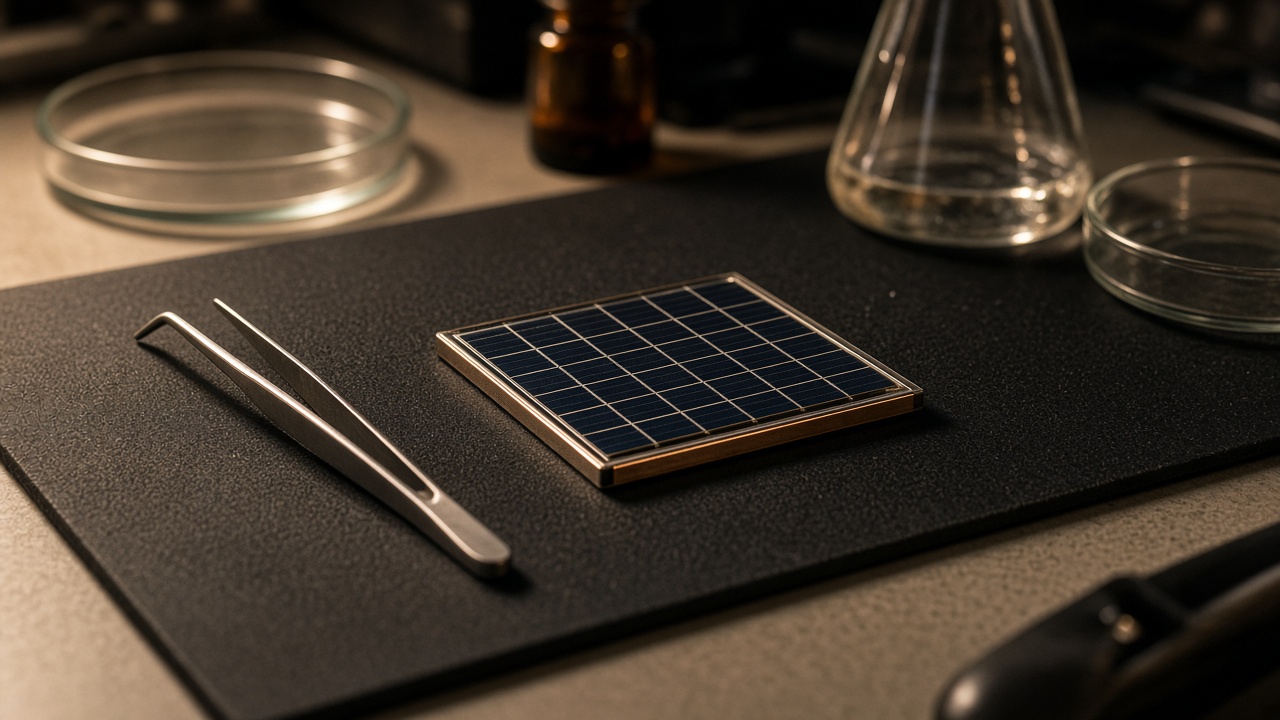
Imperial College London researchers say a room-temperature slot-die coating kept printed perovskite solar cells at ninety-two per cent of their initial efficiency after five hundred thermal cycles between fifteen and sixty degrees Celsius, a durability milestone for lightweight photovoltaics that could coat warehouse roofs without high-temperature ovens.
Leila Hassan writes that the team, led by materials scientists at Imperial's White City campus, focused on methylammonium-free compositions because earlier perovskite recipes degraded when humidity swung inside pilot halls. Slot-die coating lets factories paint active layers like newspaper ink, but brittleness at layer interfaces has blocked outdoor certification.
Why thermal cycling counts
Microcracks usually appear when flexible substrates expand faster than the electron transport layer. By adding a room-temperature buffer polymer between the tin oxide contact and the perovskite absorber, the group reduced stress without annealing steps above eighty degrees. Independent microscopy at the Diamond Light Source confirmed fewer pinholes after cycling than in control cells annealed at one hundred twenty degrees.
The work sits in the EPSRC-funded PRINTSolar collaboration, which pairs Imperial with Swansea and Oxford PrintPV teams trying to keep UK thin-film manufacturing competitive with Chinese gigawatt-scale lines. Commercial partners include a Bristol-based building-integrated photovoltaics start-up that wants panels light enough for Victorian trusses.
Path to field tests
Researchers caution that five hundred lab cycles do not equal a thirty-year rooftop warranty. Outdoor-soak trials at the Surrey Micro-PV outdoor test field begin in January with modules sealed using the group's low-temperature lamination recipe. Certification bodies still require accelerated UV and damp-heat protocols that perovskite historically failed within a thousand hours.
If field data hold, planners could integrate semi-transparent cells into south-facing atria without the fire-review arguments that dogged some early organic photovoltaics. Hassan notes that building regulations now ask for embodied-carbon worksheets on retrofits; printable cells that ship on rolls reduce crane time compared with glass-glass silicon panels.
What it is not
The cells are not yet at silicon efficiencies above twenty per cent on large areas, and lead-free recipes remain heavier than ideal. Imperial has not claimed a commercial launch date, emphasising that roll-to-roll yield still drops when ambient humidity exceeds fifty per cent without dry-room envelopes.
For UK science readers, the signal is narrower but important: room-temperature processing may be the enabling trick that lets domestic factories experiment without billion-pound foundries, keeping pilot lines in Cardiff and Manchester relevant while policymakers argue over solar import tariffs.
EPSRC programme managers said the next funding tranche will reward teams that publish reproducible coating recipes, a nudge toward open benchmarks as Chinese manufacturers scale roll-to-roll perovskite lines. Imperial has agreed to deposit precursor ink formulations in a restricted database for UK partners, stopping short of full open release until patent filings clear.