RIKEN released a curated dataset on Monday measuring dissolved oxygen in the Kuroshio Current's subsurface layers after an October research cruise, giving fisheries scientists a baseline ahead of a December government briefing on aquaculture stress linked to coastal warming.
The publication bundles sensor profiles taken along a transect south of Shikoku with laboratory calibrations performed at Wako campus, formatted for open download under a Creative Commons license with citation requirements.
Why oxygen minima matter
Oxygen minimum zones in the Kuroshio extension influence where pelagic fish concentrate and how long farmed fish can survive when upwelling weakens. Warm summers like 2026's can thicken low-oxygen lenses, pushing species toward shallower, more harvestable depths but raising mortality risk for net pens. RIKEN teams argue that routine open data cut warning times for prefectural fishery cooperatives deciding when to pause feeding during heat waves.
Cruise mechanics
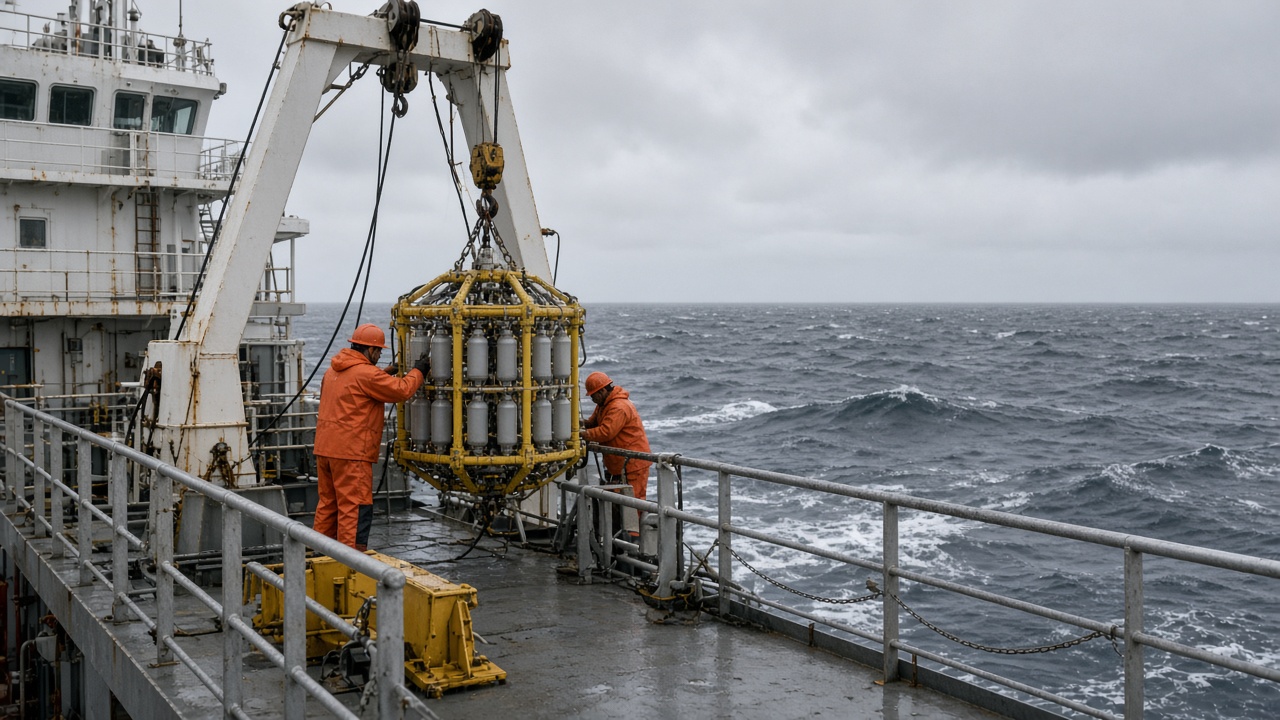
Scientists lowered conductivity-temperature-depth rosettes at twelve stations, pairing shipboard measurements with Argo float corroboration where tracks overlapped. Quality control scripts flagged two casts with possible sensor drift; those rows remain in the dataset but carry uncertainty masks explained in metadata. Graduate students uploaded processing notebooks so external labs can reproduce cleaning steps—a transparency push Japanese agencies market as competitive with European open-science norms.
Fisheries link
The Fisheries Research and Education Agency plans to merge RIKEN's oxygen fields with saury migration models before year-end stock assessments. Aquaculture firms farming amberjack in Kochi and Ehime requested the data to tune aerator schedules, citing higher electricity costs after summer typhoons disrupted grid stability. December's briefing will not set catch quotas directly but informs ministerial talking points on climate adaptation subsidies.
Climate context
North Pacific sea-surface temperatures ran above the 1991-2020 average through September, amplifying interest in subsurface oxygen trends that satellite altimeters cannot see. RIKEN authors note that low-oxygen events do not always correlate with surface heat; salinity intrusions from the Kuroshio meander matter too. The dataset therefore includes salinity channels for coupled ecosystem models universities run on supercomputers at Yokohama and Kobe.
Open science politics
Japan's science ministry encourages national labs to publish negative results and intermediate slices, not only headline papers. RIKEN's release Monday fits that mandate and may support grant renewals for the Center for Computational Science. International collaborators in Taiwan and the United States can access the same files without bilateral memorandums, speeding joint workshops planned for COP31 side events in Turkey.
Limits
One cruise transect cannot represent the entire Kuroshio; RIKEN cautions against using the download for navigation or real-time closures without prefectural validation. Sensor networks off Tokaido still recover from Saturday's earthquake inspections, delaying complementary nearshore readings. Fishers should treat the dataset as a seasonal diagnostic, not a daily forecast.
Next steps
RIKEN scheduled a webinar in Japanese and English for graduate students on parsing uncertainty masks. Fisheries officials will test whether oxygen thresholds trigger automated SMS alerts to cooperative leaders by spring 2027. For now, Monday's release gives analysts hard numbers to cite when politicians ask whether warming seas already squeeze dinner-table species—not abstract future risk, but measurable milliliters of oxygen per liter this fall.