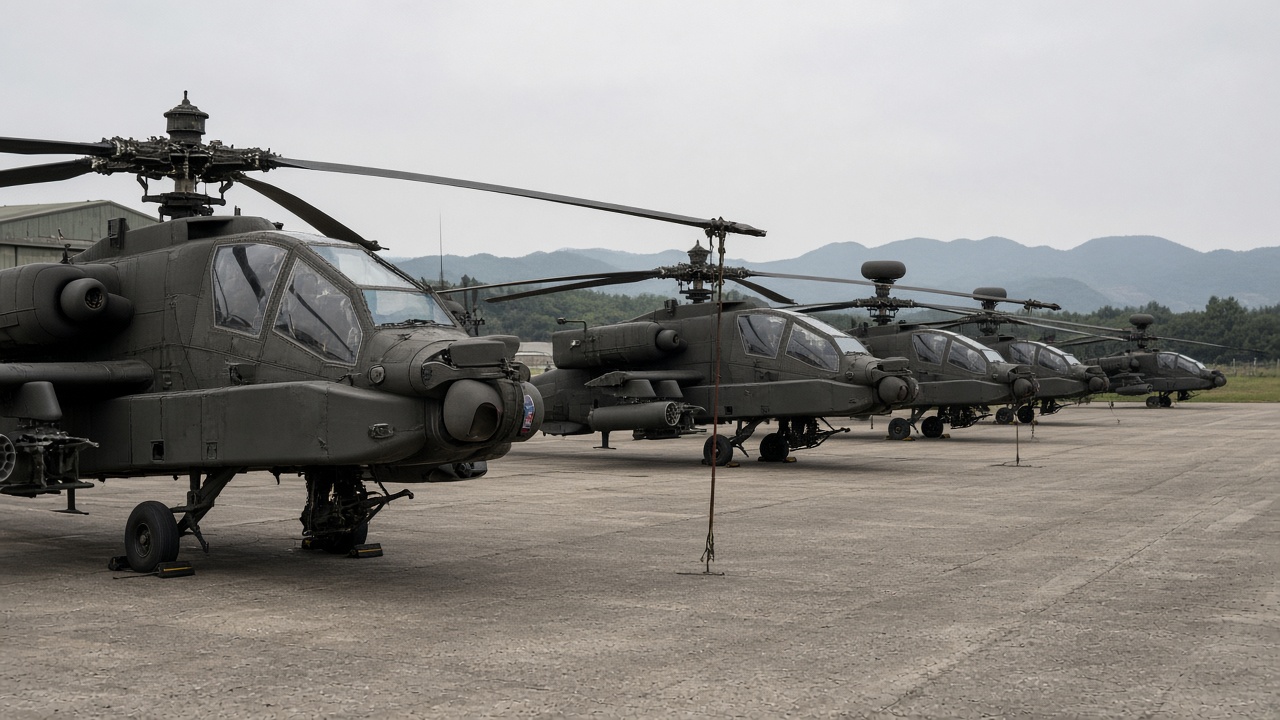
South Korea’s Army has kept its entire fleet of Boeing AH-64E Apache Guardian attack helicopters on the ground since early October while U.S. authorities inspect transmission components flagged in a safety advisory, an Army spokesperson said Tuesday, pausing routine training on all 36 airframes.
Captain Bae Seok-jin told reporters the grounding followed guidance from the U.S. military about a possible transmission-system defect. Inspections are proceeding in phases with U.S. technicians, and helicopters will return to flight only after each aircraft clears the checks, he said.
What changed in October
Bae said the advisory arrived in early October and the Army immediately stopped sorties as a precaution. The AH-64E serves as a key air-to-ground platform for the Republic of Korea Army, which fields 36 Guardians bought under a long-running procurement program with the United States.
During the grounding, crews maintain weapons and sensors so aircraft can still launch on short notice if a contingency order arrives, Bae added. Only scheduled training cycles are affected.
Alliance maintenance channel
Joint U.S.–Korea logistics arrangements mean defect notices on American-designed rotorcraft typically flow from U.S. program offices to foreign operators. Army officials declined to specify which subcomponent triggered the advisory, citing the ongoing inspection.
Defense Minister Kang Shin-chul told lawmakers Monday that the Cheonghae anti-piracy unit would stay outside the Iran war even as its patrol area moves closer to the Gulf. The Apache grounding is unrelated to that deployment debate but highlights how safety holds can narrow training margins while regional tensions stay elevated.
Pilot community and timelines
Apache units rotate through gunnery and formation drills on a fixed calendar. With every Guardian idled, instructors are shifting to simulator blocks and classroom maintenance briefings. The Army has not published a fleet-wide return-to-fly date, saying releases will be sequential rather than all at once.
Boeing, which manufactures the AH-64 family in the United States, routinely issues airworthiness communications that partner militaries mirror. If inspections uncover systemic wear patterns, operators across the Apache user community could see similar pauses.
Yonhap reported that routine training flights are paused but the helicopters remain configured for immediate operational launch if a contingency order is issued. The Army said there are currently no issues with readiness or operational posture despite the inspection hold.
What commanders watch next
Lawmakers on the National Assembly’s defense committee asked whether the grounding affects deterrence messaging toward North Korea. Bae repeated that no readiness gaps have appeared in classified briefings. Publicly, the focus remains on clearing each transmission inspection and documenting findings for both Korean and U.S. safety boards.