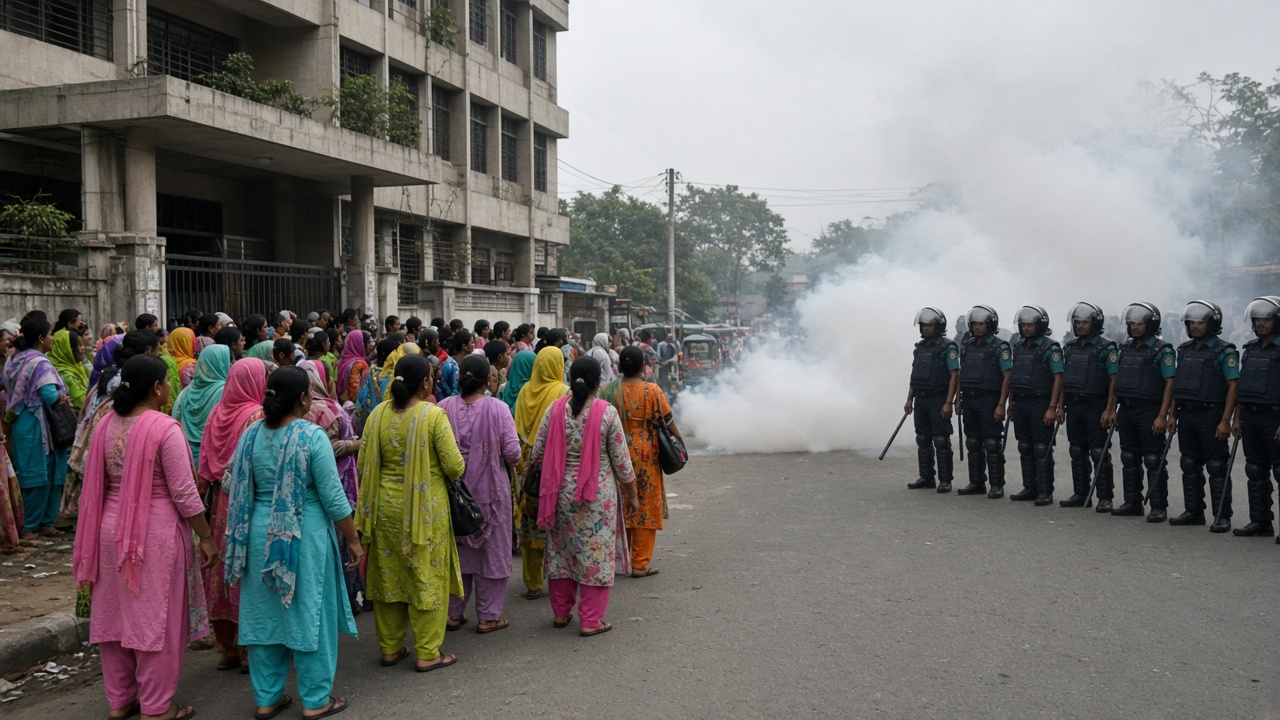
Production at 481 Bangladesh garment factories stood still on Tuesday as workers demanding a higher minimum wage blocked highways around Dhaka, clashed with police and forced the government’s wage board to publicly narrow — but not close — the gap between owners and unions.
The Bangladesh Garment Manufacturers and Exporters Association told The Business Standard that 397 member factories suspended operations and another 84 declared indefinite closures under Section 13(1) of the labour law. A senior BGMEA official said most affected plants sat in Gazipur, with additional halts in Savar and pockets of Dhaka’s Mirpur industrial belt.
Highways blocked after a false death rumour
Ready-made garment workers in Gazipur cut traffic on the Dhaka–Tangail and Dhaka–Mymensingh corridors Tuesday morning, according to police and industrial-zone officials. Tensions spiked in Konabari after a rumour that a worker had died at Islam Garments; Gazipur Industrial Police Superintendent Mohammad Amjad Hossain told Reuters no worker had died.
Police said they used tear-gas shells and sound grenades to disperse crowds that refused to leave the roads. Fresh clashes erupted in Kathgara, Ashulia, on Tuesday evening when workers threw bricks at factory gates, Ashulia Industrial Police-1 Superintendent Mohammad Mominul Islam Bhuiyan said. Authorities declared general holidays at 94 factories during the day, including 70 in Gazipur and 24 in Savar, police tallies showed.
Wage board discloses rival monthly figures
Minimum Wage Board Chairman Syed Azad Subhani told reporters Tuesday that factory owners proposed a monthly floor of Tk15,700, while worker negotiators have pressed for Tk22,000 after weeks of street protests. The current legal minimum is Tk12,500. Reuters reported worker groups have sought Tk30,000, citing food, housing and transport costs; industry groups warn a double-digit percentage jump would strain margins when global orders are soft.
Subhani said talks continued and that the board hoped to finalise a structure later Tuesday. Even before the street action, BGMEA estimated that 18 days of earlier disruptions had cost 317 factories about $428 million in lost output, with buyers shifting roughly $254 million in orders to rivals over delay risk.
Why retailers far from Dhaka are watching
Bangladesh is the world’s second-largest garment exporter after China, supplying chains for H&M, Gap, Walmart and dozens of fast-fashion labels. More than four million people work in the sector, which generates more than four-fifths of national export earnings. A prolonged halt at hundreds of plants raises the chance of air-freight penalties and inventory gaps in Europe and North America as holiday seasons peak.
Industrial police in Gazipur and Savar said paramilitary forces were deployed along some blocked routes after shopkeepers shut premises near protest lines. BGMEA leadership told reporters it wanted an immediate settlement “to save our industry,” without endorsing either wage figure.
What happens next hinges on whether Subhani’s board can issue a binding award Tuesday night or whether another rumour or highway blockade pulls more plants into holiday declarations. BGMEA’s 481-factory count is the clearest measure so far of how much output Tuesday’s unrest has already taken offline.