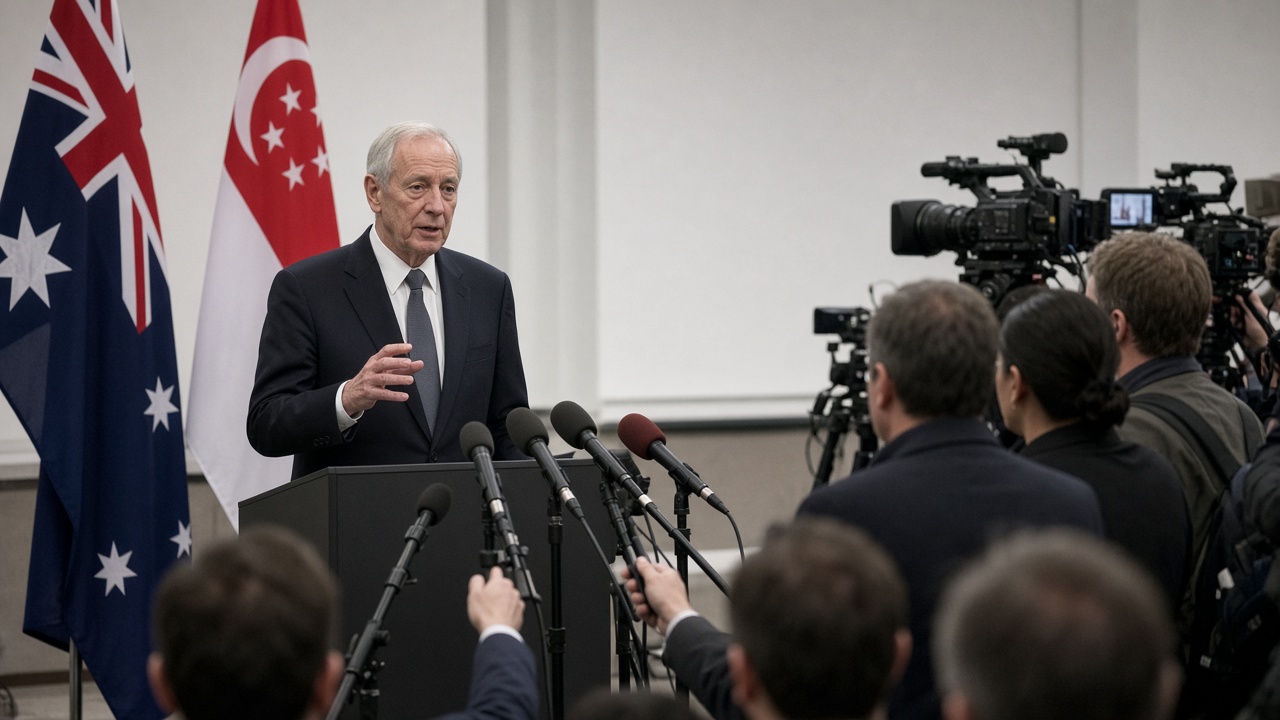
Singapore and the United States are sketching a mechanism that would let American authorities enforce their own AI chip export controls on hardware that passes through the city-state’s ports and data corridors, Prime Minister Lawrence Wong said Tuesday alongside Australian Prime Minister Anthony Albanese in Canberra.
Wong told reporters the U.S. has a “growing interest” in chips that are transshipped or rerouted through Singapore, and that both governments are working on information-sharing to trace consignments whose ultimate users are hard to verify. He described the tracking problem as a “complex undertaking” during questions after the eleventh Singapore–Australia Annual Leaders’ Meeting.
What Singapore will — and will not — police
Wong repeated a line Singapore officials have used since Washington tightened advanced-semiconductor licensing: the republic does not enforce U.S. export rules itself, but it does not want to be “used and abused” as a conduit for companies that circumvent them. Facilitating U.S. checks, he said, runs parallel to domestic enforcement against firms that break Singapore law.
He pointed to Megaspeed International, a Singapore-registered trader that authorities are reviewing after export paperwork drew U.S. interest. Wong said chips Megaspeed bought from Nvidia “did not even enter Singapore” and were routed to other countries, limiting what domestic investigators can verify without foreign documents. Investigations continue, he said, and Singapore has asked Washington for more end-user data; not all requested information has been shared.
Huang release and the Nvidia board reversal
When Australian journalists asked whether Singapore had raised Megaspeed and related cases with the U.S. in 2025, Wong said Singapore investigated Alice Huang thoroughly, questioned her in custody and later released her because there was “no basis for further prosecution,” quoting his Tuesday remarks. He added that America “understands” that outcome.
The press conference unfolded hours after Nvidia said it was reinstating Jensen Huang as chief executive, reversing a board decision from earlier in November. Wong declined to comment on U.S. personnel moves, saying Washington must run its own probes. He stressed that Singapore’s priority is whether local entities breached domestic statutes, independent of management changes at U.S. suppliers.
ALM agreements and why chips dominated questions
Tuesday’s summit also produced accords on carbon capture, artificial-intelligence cooperation and supply-chain resilience for food and pharmaceuticals. Wong said those pacts would eventually ease business for Singaporean companies in Australia, even if the items are not “immediately relevant” to households.
Chip diplomacy nonetheless overshadowed the bilateral package because Singapore hosts major transshipment volumes and because U.S. export-licence rules have pushed traders to document every hop between fabs and data centres. Wong’s remarks signal that any enforcement channel would focus on verification and document exchange rather than Singapore applying U.S. penalties directly.
Analysts watching the Megaspeed probe will look for whether American customs data start flowing before the next licensing cycle. Until then, Wong’s Canberra comments set the public frame: Singapore will cooperate with U.S. enforcement on U.S. rules, while keeping its own prosecutorial bar on local law violations.