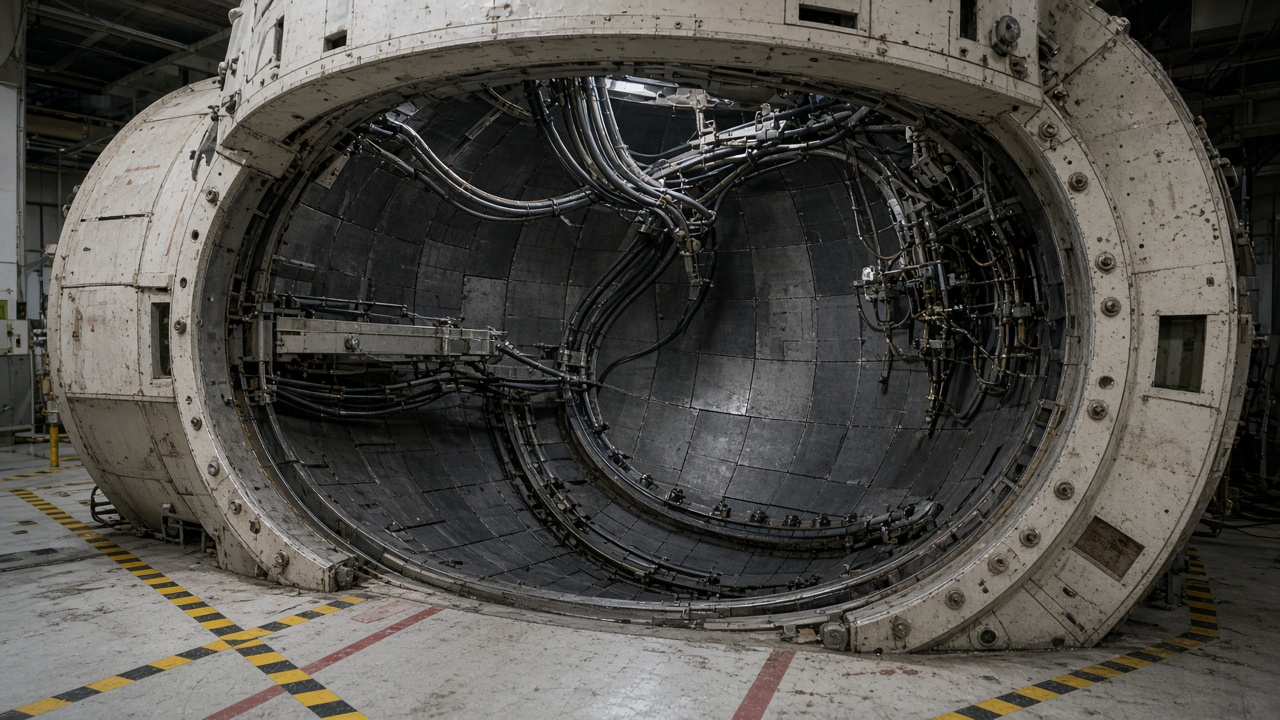
Experiments on the UK’s MAST Upgrade spherical tokamak show that divertor power-sharing can flip between upper and lower exhaust paths within a single plasma pulse when magnetic geometry drifts, researchers report.
The findings, described in detail in mid-November technical coverage, matter for STEP, the UK’s prototype fusion plant programme, which plans a double-null divertor configuration to spread heat loads.
Why divertors matter
Fusion plasmas reach temperatures far beyond any material’s melting point. Divertor tiles at the bottom—and sometimes the top—of the vessel catch charged particles and heat. If too much power hits one region, tiles erode and contaminants poison the reaction.
MAST Upgrade’s compact apple-core shape lets engineers test control schemes faster than on larger international machines. Collaborators from the Dutch institute DIFFER modulated magnetic balance up to 200 times per second and saw target conditions change immediately, leaving almost no time for feedback controllers to compensate.
Control challenge
That result pushes responsibility upstream: reactors may need to hold balanced magnetic nulls continuously rather than correcting after sensors detect hot spots. It is akin to demanding a pilot keep wings level in gusts instead of relying on late autopilot corrections.
Separately, UKAEA teams have reported progress suppressing edge instabilities known as ELMs with resonant magnetic perturbation coils, and injecting record power into the plasma. The divertor work adds another layer—steady exhaust management while instabilities are tamed.
Path to STEP
Data from MAST Upgrade feeds design choices for STEP’s coolant circuits and tile materials. Private fusion startups at Culham watch the same experiments to benchmark their own compact reactor claims.
The government’s AI for Science Strategy also names Culham as a growth zone where simulation and experiment loop together. Divertor modelling is exactly the sort of workload earmarked for expanded compute allocations.
What comes next
Expect follow-on campaigns testing active control algorithms and new gas fuelling strategies to stabilise density. Fusion remains pre-commercial, but each MAST result narrows the list of surprises that would greet engineers on a grid-connected demonstrator.
Materials science
Tile erosion releases impurities that cool plasmas below fusion-relevant temperatures. Modelling how fast misalignment appears helps engineers pick tungsten versus carbon-based armour for STEP.
Private investors in compact fusion watch MAST publications because the machine produces peer-reviewed data far cheaper than full-scale tokamaks still under construction abroad.
UKAEA teams will next test whether AI-guided magnetic control can hold balance faster than 200 hertz oscillations observed with partners in the Netherlands.
Reader checklist
Watch official statements, filings and regulator portals today rather than relying on hallway briefings. When numbers land, compare them with what households, patients and investors were told last quarter and note what changed in the fine print.
Local coverage from trade press and parliamentary records will update through the afternoon; refresh chips if documents post after this story went live.