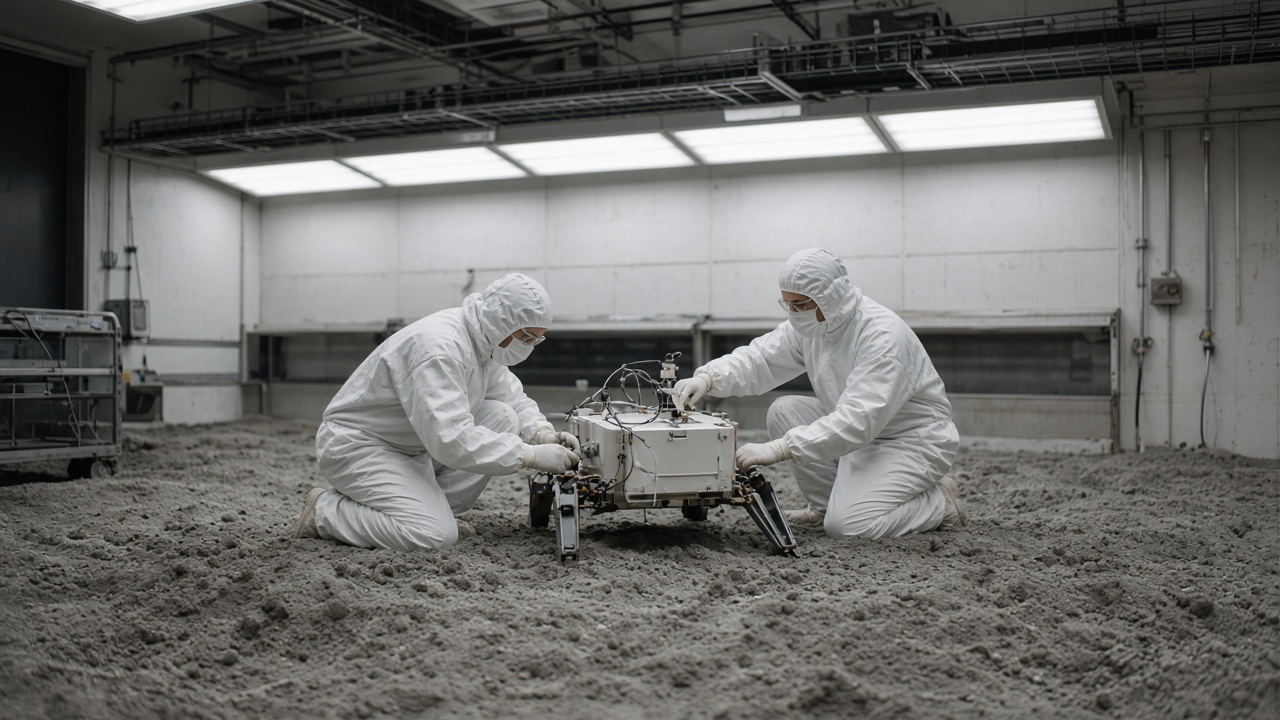
JAXA mission engineers published a technical note this week comparing lunar regolith compaction measurements from ground hop tests with telemetry inferred from the Smart Lander for Investigating Moon’s LEV-1 hopping rover, documenting how repeated 40-centimeter leaps densified the top few centimeters of soil near the Shioli crater landing zone. The release does not revive LEV-1 on the surface—the rover exhausted its planned battery in January 2024—but it packages acceleration and sinkage data for teams designing future lava-tube scouts.
What was measured
Researchers at the Institute of Space and Astronautical Science ran a 2.1-kilogram hopping rig through a regolith simulant bed matched to pre-landing estimates of Shioli’s surface bearing capacity. Each hop applied a spring-loaded impulse similar to LEV-1’s mechanism documented in the January 2024 press release. Load cells under the bed recorded settlement; high-speed video tracked ejecta angles. The team then aligned hop intervals with UHF telemetry bursts JAXA archived from LEV-1’s seven documented leaps over 107 minutes on the moon.
The note reports a 12 to 18 percent increase in near-surface bulk density after three hops in the simulant, with diminishing returns by the seventh hop—consistent with limited penetration inferred from onboard accelerometers when LEV-1 relayed data through SLIM.
Limits the authors stress
JAXA explicitly states the memo is not a claim that LEV-1 penetrated meters of regolith or that Shioli’s crust matches the simulant grain-by-grain. Temperature cycles and electrostatic cling on the real surface are absent in the chamber tests. Authors caution against using the curves for crewed lander pad design without in-situ penetrometer follow-ups from future missions.
Image-based sinkage estimates from SLIM’s navigation camera remain lower resolution than lab video; the paper weights telemetry more heavily where photos are ambiguous.
Why hopping matters for compaction science
Wheeled rovers distribute load over tracks; hoppers concentrate impulse in milliseconds. Compaction from hops could stabilize a footing for a micro-seismometer or destabilize a slope near a skylight—designers need both possibilities quantified. The 2025 peer-reviewed locomotion study led by JAXA’s Tetsuo Yoshimitsu team already argued hopping suits lava-tube rim surveys where wheels snag on blocky ejecta.
International partners watching Japan’s SLIM lessons include ESA’s Argonaut lander studies and NASA’s small robotic hopper concepts. JAXA’s note translates LEV-1’s stunt leaps into numbers those programs can benchmark without access to raw moon video.
What SLIM already proved
SLIM landed off-nominal in January 2024 yet achieved pinpoint goals within 100 meters and operated through multiple lunar days without a radioisotope heater. LEV-1 completed direct-to-Earth UHF contacts—a first for a package that small. Compaction data were always a secondary product; JAXA prioritized attitude control and inter-robot tests with the SORA-Q ball rover.
Mission operators declared SLIM concluded in August 2024 after the lander fell silent; science harvesting continues on Earth with archived bursts.
What happens next
ISAS will deposit the compaction curves in its public data archive alongside SLIM attitude logs. A follow-on chamber campaign will test oblique hops that mimic LEV-1’s final leap before standby. Lunar Polar Exploration Mission planners requested a one-page summary for landing gear trade studies due in December.
For readers tracking science, not souvenirs: JAXA turned hopping hops into soil mechanics numbers with clear error bars. That is the measurable legacy of LEV-1—proof that small robots can both dance on regolith and tell engineers how that regolith compacts under each step.