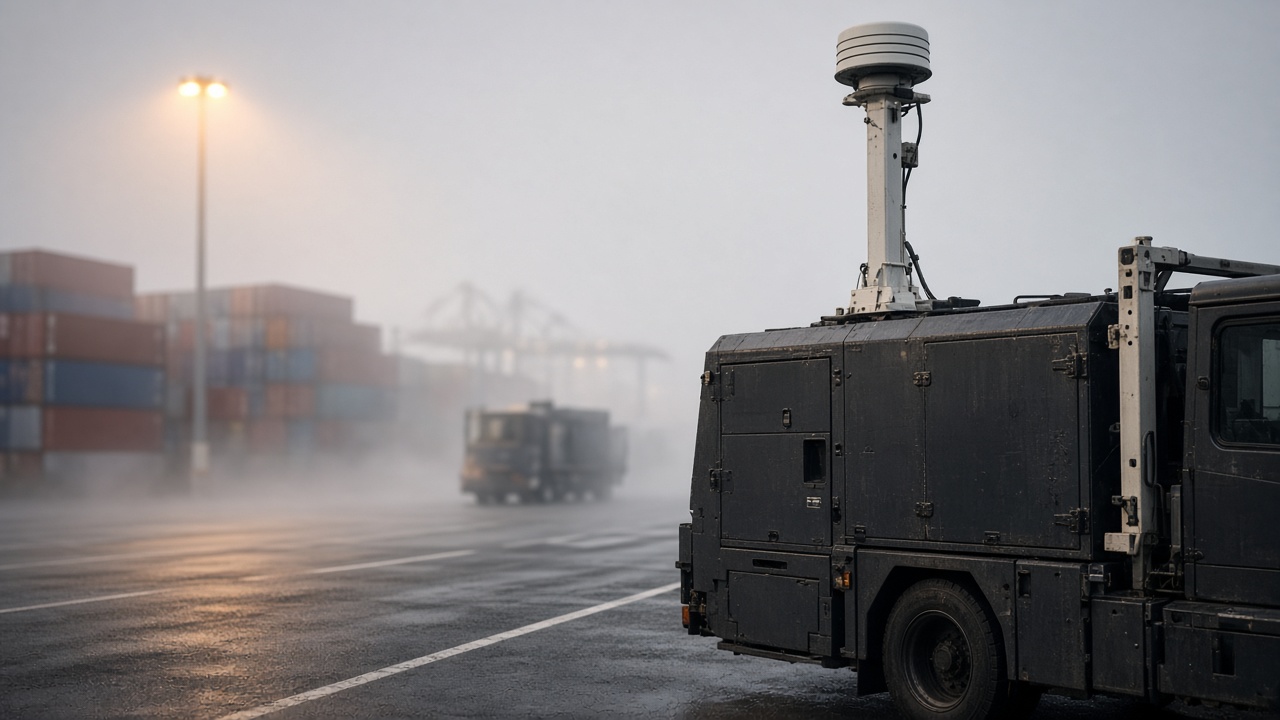
The Korea Research Institute of Standards and Science published an open dataset Monday linking coastal lidar fog profiles to Busan container convoy slowdowns, giving port planners 20-minute visibility forecasts when autumn sea fog stalls truck gates. The release covers 46 days of synchronized scans from a mast near Busan New Port’s northern gate.
Measurement design
KRISS teams used a 1.5-micron doppler lidar sampling every 30 seconds at 15 vertical gates up to 600 meters. Truck GPS probes on 120 drayage units supplied ground truth for queue lengths when visibility dropped below 400 meters—the threshold Busan Port Authority uses to throttle gate releases.
Researchers masked license plates and container codes in public files; only timestamps, visibility estimates, and convoy speed bins remain. The dataset is roughly 880 gigabytes hosted on KRISS’s science cloud with a CC-BY license for municipal and academic reuse.
Operational payoff
During September 2025 field work, planners tested a “convoy clock” dashboard that texted gate supervisors when lidar trends predicted sub-threshold visibility before cameras fogged over. Median truck idling fell 11 minutes on test mornings, Busan Port Authority said in a letter supporting the publication.
Korea Meteorological Administration marine forecasts still cover the region, but their grid cells are too coarse for gate-level decisions. KRISS argues lidar fills the gap between synoptic warnings and windshield judgment.
Limits
The instrument sat fixed at one mast; other Busan terminals may see different fog advection. Salt spray fouled lenses twice weekly—cleaning logs are part of the dataset so replicators know downtime bias.
KRISS does not claim predictive skill beyond 20 minutes; longer horizons failed cross-validation when wind shifted abruptly off Hwangnyeongsan.
Replication
Institute scientists said any Korean lab with a class-3R lidar and port cooperation could reproduce the pipeline; IBS does not yet host a duplicate mast. Shipping lines worry about competitive leakage if convoy clocks go public—KRISS withheld carrier names and cargo categories.
Next steps
Busan planners will decide in November whether to fund a permanent mast or lease mobile units during fog season. KMA is reviewing whether to ingest KRISS visibility feeds into marine SMS alerts, a process that requires inter-agency data agreements not yet signed.
Port economics
Each minute of gate delay during fog season costs drayage firms fuel and demurrage; BPA economists estimated the pilot dataset could save 140 truck-hours per fog week if supervisors stagger releases using lidar trends instead of camera guesswork.
KRISS paired with Pusan National University engineers to validate vertical fog advection models against the mast data; a peer-reviewed methods paper is forthcoming, but the raw files are already downloadable for replication tests.
Other Korean ports—Incheon, Ulsan—asked for copy-paste mast designs, though KRISS cautioned that Busan’s canyon-like container stacks create microclimates not seen on Incheon’s flatter yards.