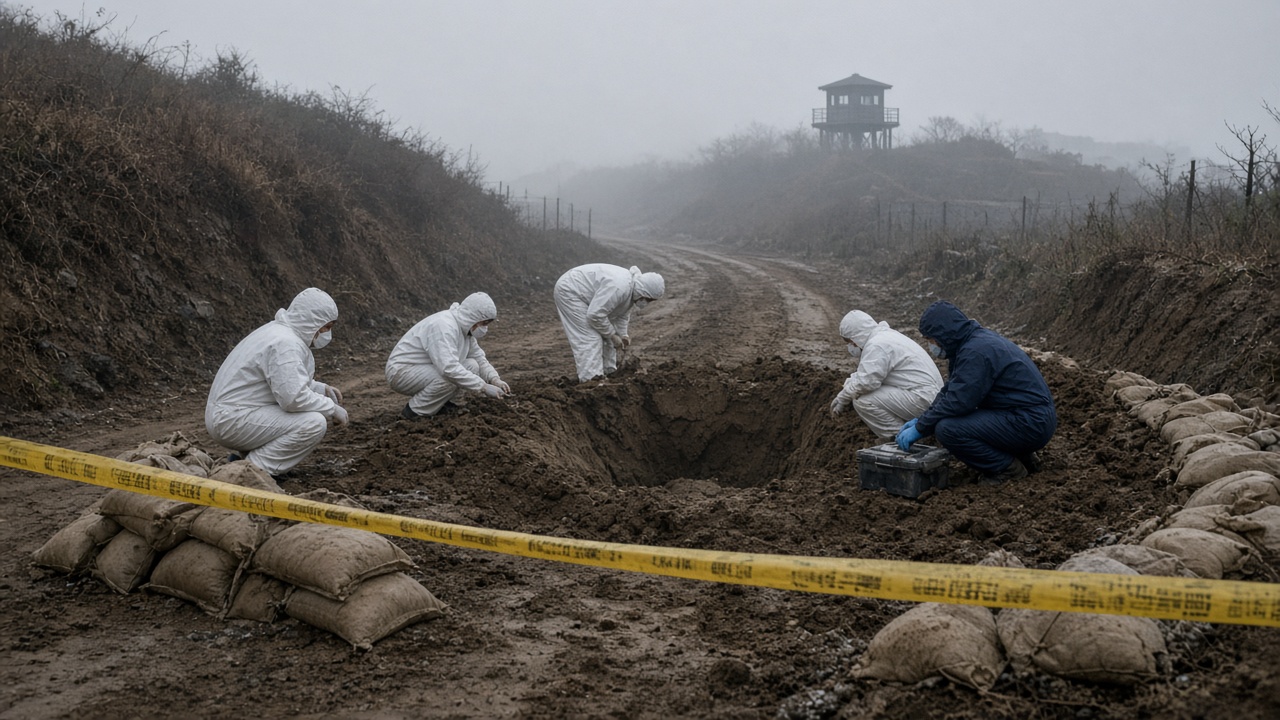
We should be able to say that when a blast injures three service members near the Demilitarized Zone, the forensics team is on site before the crater changes. Instead, the Sept. 21 Paju explosion was followed by a wait that stretched to Sept. 27, when the UNC–ROK joint investigation finally began—moved up from Sept. 29 only after the UN Command pressed for a prompt probe. That six-day interval is the editorial's central claim: it is a credibility problem, not a partisan talking point.
The timeline matters. South Korean military officials entered the DMZ on Sept. 26 for environmental preparation, five days after the blast. The joint forensic investigation was originally set for Sept. 29, then advanced to Sept. 27. By the time investigators reached the site, the scene had been exposed to weather, traffic, and the ordinary pressures of a heavily guarded frontier. A blast site is evidence. Every hour of delay increases the chance that soil, residue, and fragments tell a weaker story. If the explosion was caused by a mine, the forensic chain matters for accountability. If it was caused by something else, the same chain matters for preventing the next injury.
Safety promises need a clock
The government says it takes troop safety seriously. That claim is not disproved by one delay alone, but it is weakened when the response looks reactive. A serious safety system would have a standing protocol for incidents in the DMZ: who enters, when, under what armistice notification, with what forensic kit, and how the site is secured. The fact that the UN Command had to push for a prompt investigation suggests the protocol is either incomplete or not exercised. Either way, the burden is on the government to explain the sequence, not on critics to prove bad faith.
The strongest objection is operational. The DMZ is not a normal crime scene. Mine risk, unexploded ordnance, weather, narrow access roads, and the 1953 Armistice Agreement all constrain movement. Rushing investigators into an unsafe area could produce more casualties. Those constraints are real, and they should not be dismissed. But they are an argument for preparation, not for a six-day gap. If the area was too dangerous for forensic teams on Sept. 22, why was it safe enough for environmental preparation on Sept. 26? If coordination with the UNC was the bottleneck, why is there no public timeline showing which approval took how long? Operational caution explains a delay; it does not explain the absence of a pre-agreed rapid-response mechanism.
Opposition politicians, including Han Dong-hoon, have seized on the incident, saying the Lee government cannot defend the DMZ. We do not need to adopt that broad indictment to recognize the narrower problem. Partisan outrage is not a forensic method, and a blame fight will not secure the crater. But the governing camp cannot use the opposition's tone as an excuse to avoid the substance. The question is not whether Han is right about the entire government; it is whether the government can produce a credible account of why it took six days to get investigators to an active incident site.
What should happen now
First, the Defense Ministry and the Joint Chiefs of Staff should publish a detailed timeline within days, not weeks: the moment of the blast, the first report, the UNC request, the approval chain, the environmental prep, and the start of the joint probe. Redactions for operational security are acceptable; silence is not. Second, the UNC and South Korea should turn the ad hoc arrangement into a standing DMZ incident protocol, with a named forensic team, pre-positioned equipment, and a 24-hour target for site access when safety allows. Third, the National Assembly defense committee should hold a hearing focused on procedure, not theater, and ask for a written after-action review. Fourth, if contamination or delay has compromised evidence, officials should say so and explain how they will reconstruct the facts through other means, including medical evidence, blast analysis, and witness statements.
The three injured service members deserve more than statements of concern. Their injuries are a reminder that the DMZ's danger is not abstract. Troop safety is measured in minutes and hours, not in press releases after the fact. A six-day wait does not prove that every official was careless. It does prove that the system did not perform as a safety-first system should. The government can still repair that credibility, but only by replacing improvisation with a protocol and by showing the public the timeline it has so far left blurred.