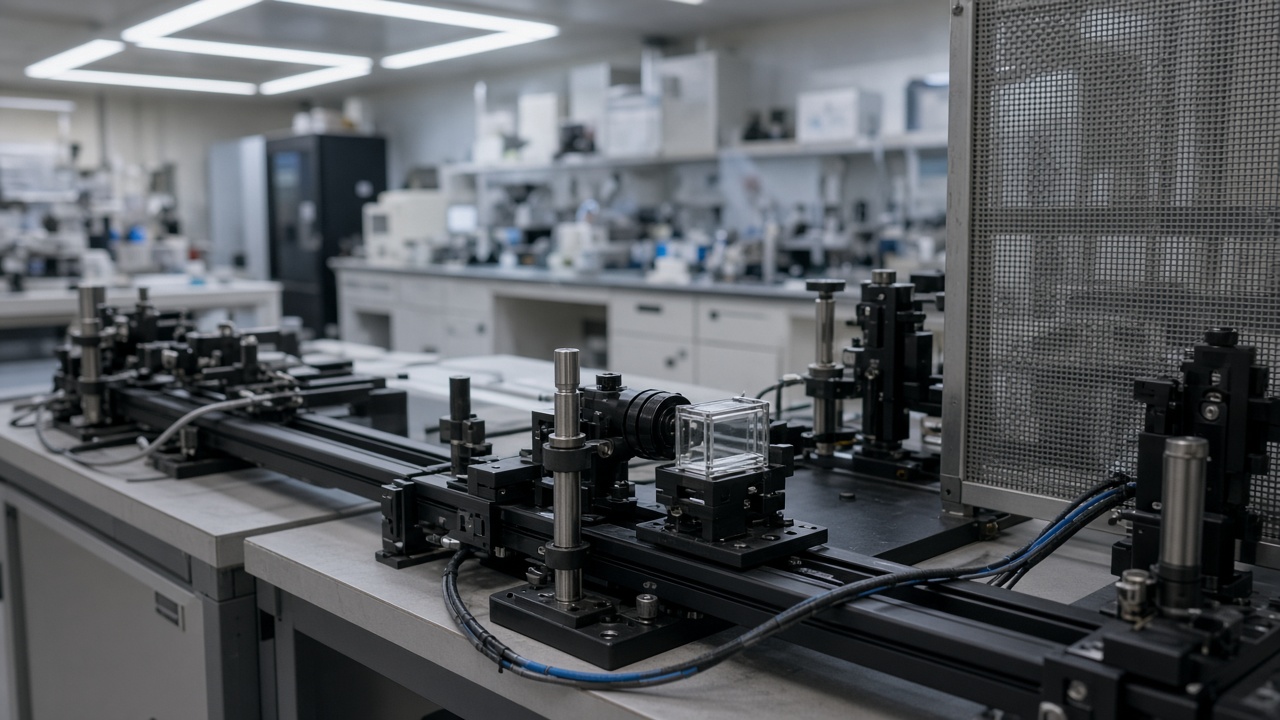
KAIST chemistry professor Hyotcherl Ihee and colleagues filmed azobenzene’s light-triggered bend at the Pohang Accelerator Laboratory X-ray free-electron laser, capturing picosecond structures that settle whether the molecule twists via rotation, inversion, or a coupled hula motion—a result drug designers need before wiring optical switches into therapies.
Why azobenzene matters
Azobenzene’s two benzene rings flank a nitrogen bridge; visible light flips them from a straight trans shape to a bent cis form without adding atoms. Photopharmacology teams use that flip to turn drug activity on and off; materials scientists use it in light-responsive films.
Spectroscopy showed before and after states, but intermediates vanished too fast for cameras. Competing theories argued rotation around the bridge, in-plane inversion, or combined twists.
Experiment design
The group dissolved azobenzene in methanol and fired a laser pulse to start the reaction, then probed with X-ray pulses delayed by picoseconds. Time-resolved liquidography records scatter patterns that reconstruct atomic positions at each delay.
Light atoms scatter weakly; the team tuned pulse intensity and sample concentration until signal rose above solvent noise. PAL-XFEL’s pulse length made the difference versus synchrotron attempts that blurred the motion.
What the frames show
Published analysis points to a dominant inversion pathway with measurable rotation components at specific delays, reconciling prior spectroscopy papers that appeared contradictory because they averaged different time windows. The group posted delay-series plots for peer review alongside raw scatter files.
Pharmaceutical collaborators said the data will guide which azo derivatives survive aqueous blood environments without snapping back before receptors engage.
Korean facility angle
PAL-XFEL is one of few XFELs worldwide offering the pulse train chemistry groups need; Ihee directs the IBS Center for Advanced Reaction Dynamics co-located with KAIST. Ministry of Science and ICT officials cited the result in a briefing on keeping domestic beamtime competitive as Japan and Germany upgrade rival lines.
What comes next
Follow-up runs will test substituted azobenzene drugs tethered to proteins, a harder scatter problem. Jaemin Yoon’s desk will watch whether industry partners license the timing data for OLED dopants as well as pills—because the same picosecond movie sells both photopharmacology grants and display R&D tax credits.
Beamtime economics
University groups share PAL-XFEL shifts through peer review; missing a weather window can cost a semester of graduate work. Ihee’s team queued backup solvent systems after a humidity spike delayed one overnight run in September, a reminder that chemistry beamtime is as schedule-sensitive as semiconductor fab downtime.
Graduate students posted delay logs showing how many picosecond steps each run captured; open data let competing labs reproduce the inversion assignment without rerunning the full laser series. Peer reviewers asked for the same files before formal publication.