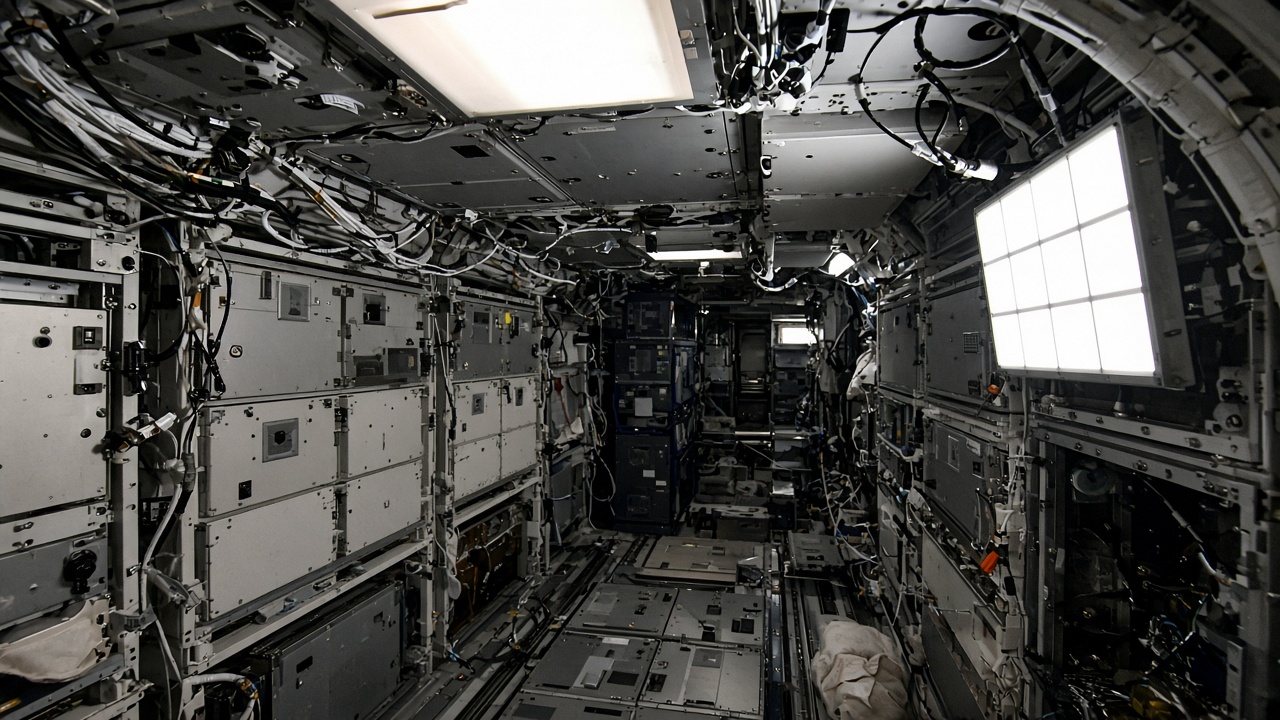
JAXA said Friday its DRCS carbon dioxide removal demonstrator on the Kibo module will standardize a 50-minute scrub cycle after on-orbit tests showed that timing balanced absorbent cooling and cabin ventilation better than shorter or longer programs.
The Demonstration of Removing Carbon-dioxide System arrived on the International Space Station in November 2025 aboard an HTV-X cargo mission. Engineers now treat the cycle choice as the baseline for a full-scale unit destined for the Gateway lunar station’s international habitation module.
Why microgravity mattered
Ground models predicted performance, but teams needed proof that pressure-temperature swing absorption behaves the same in orbit. Flight data matched bench results at a dew point of 5 degrees Celsius, with a removal rate of 0.78 grams per minute at 2.88 millimeters of mercury partial pressure.
That match lets designers scale hardware without adding the margin that usually inflates spacecraft mass.
Cycle trade-offs
Tests compared 40-, 50-, and 60-minute programs while cabin CO₂ hovered between 2.0 and 2.6 millimeters of mercury. Fifty minutes maximized absorbent reuse without starving ventilation fans during cooling phases.
Operators on Earth uplink commands during crew sleep to avoid competing with other Kibo payloads such as materials furnaces and imaging rigs.
Gateway linkage
Japan agreed to supply environmental control gear for Gateway’s I-HAB segment. DRCS is the risk-reduction path before committing to a higher-capacity system that must run for months without shuttle resupply.
Partners at NASA and ESA reviewed the October telemetry package last week, according to JAXA’s press office.
Public outreach
JAXA will stream a Kibo classroom session on 12 October explaining how CO₂ scrubbers differ from household air purifiers. Schools in Okinawa and Tsukuba submitted questions about astronaut health during long lunar stays.
Power and mass budgets
DRCS draws less power than legacy amine systems tested in the 1990s, freeing kilowatts for science racks on Gateway. Engineers said the flight unit’s mass is roughly 40 percent of a production I-HAB scrubber, with most savings coming from shared fans with the cabin circulation loop.
Follow-on tests in 2027 will stress the sorbent beds with higher CO₂ loads mimicking four-astronaut crews on lunar sorties.
Station logistics
The 50-minute scrub cycle matters because cargo ships arriving at the International Space Station cannot berth if CO₂ levels in the U.S. segment spike during crew sleep. JAXA’s regenerative system on Kibo shares data with NASA life-support teams ahead of a December reboost that will shift orbital altitude for debris avoidance.
Engineers said the milestone frees astronaut hours previously spent on manual cartridge swaps, allowing more time for materials experiments sponsored by Japanese manufacturers. A failed valve in August had stretched the tuning process, reminding managers that station hardware ages faster than ground copies.
Ground teams at Tsukuba will mirror scrub-cycle telemetry through December to certify backups before cargo traffic picks up after the New Year.
Why the cycle length matters
Carbon dioxide scrubbers on station modules must match crew metabolic output across sleep and exercise blocks. A 50-minute loop means filters regenerate before concentrations trip alarms that would force astronauts into masks and halt science racks. NASA’s mission control in Houston said Japanese telemetry matched U.S. sensors within two percent during the final test week, clearing the hardware for routine ops rather than engineering watch.
JAXA managers noted that Kibo’s exposed facility still hosts external experiments that cannot pause for life-support maintenance, so reliable scrubbing inside the pressurized module is a prerequisite for keeping those payloads powered. Commercial resupply flights scheduled for January will carry spare sorbent beds anyway, a hedge against the aging valve that delayed certification in August.