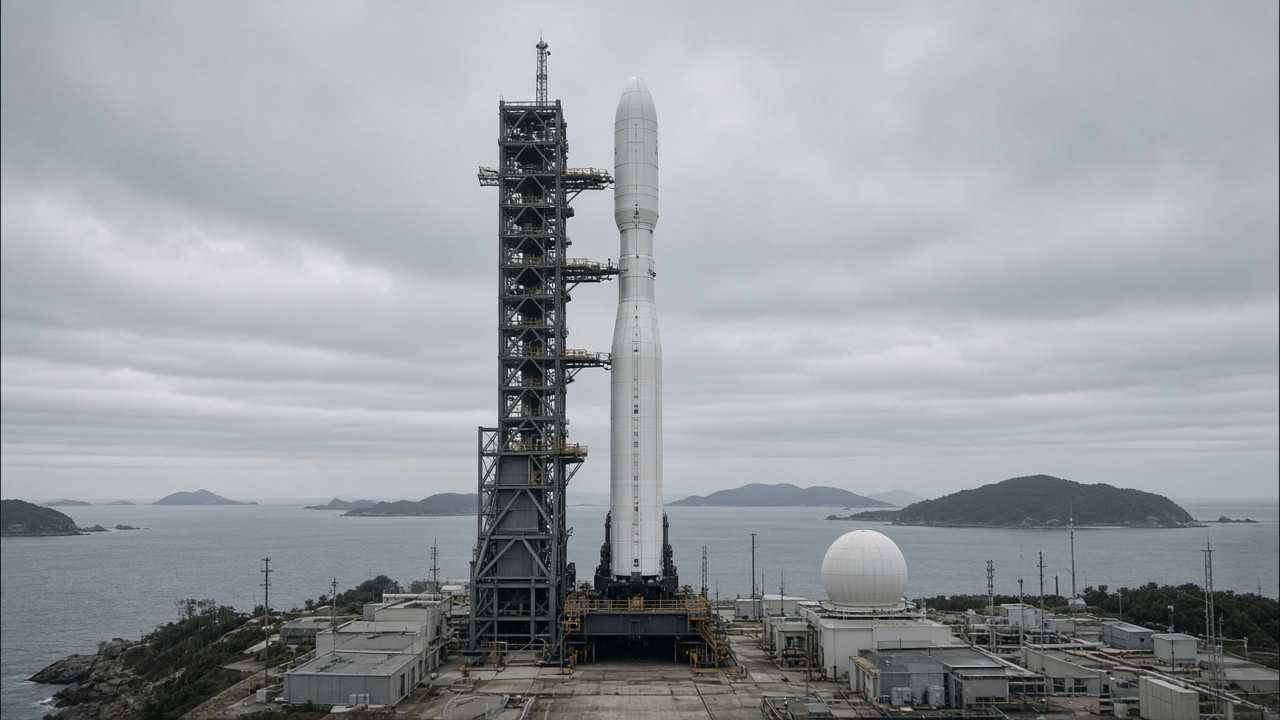
GOHEUNG — South Korea’s fifth Nuri rocket stood vertical at the Naro Space Center on Tuesday after overnight transport from the assembly building, with controllers preparing to launch a record 15 satellites on Wednesday afternoon.
The Korea AeroSpace Administration (KASA) said the launch management committee would meet Wednesday morning to review propellant loading, weather and collision risks before fixing a time inside a window from 12:23 p.m. to 1:23 p.m. If the flight proceeds, it would be the first Nuri mission to place five identical NEONSAT microsatellites into orbit in a single sequence—a step toward imaging the Korean Peninsula more than three times daily once the full constellation is flying.
Payload and deployment plan
The primary passengers are NEONSAT units 2 through 6, part of the New-space Earth Observation Satellite Constellation for National Safety program led by KAIST’s Satellite Technology Research Center with Satrec Initiative supplying buses and cameras. Ten CubeSats ride as secondary payloads, bringing the total to 15—the largest batch Nuri has carried.
Controllers plan to release the microsatellites at staggered angles so the spacecraft do not collide, requiring the third stage to rotate roughly 180 degrees during separations. After the last deployment, Nuri will vent remaining propellant and perform a collision-avoidance maneuver before re-entering the atmosphere, with the entire flight lasting about 20 minutes, according to KASA and the Korea Aerospace Research Institute (KARI).
Industry role on the fifth flight
Unlike earlier government-only launch teams, Hanwha Aerospace—the Nuri system prime—will analyze telemetry alongside KARI, part of a gradual transfer of ground operations to industry before the sixth flight. Officials said Hanwha is expected to take a leading role in ground control on that next mission, which is slated to loft the remaining five NEONSAT spacecraft in 2027 to complete the 10-satellite constellation.
The fifth launch was postponed from early October after thruster checks on several CubeSats, underscoring how crowded manifests increase schedule risk even for a rocket that succeeded on its previous two attempts.
Why Seoul is watching
A successful multi-drop flight would validate Nuri as a constellation launcher, not only a single-payload workhorse, at a moment when Seoul is expanding space budgets and encouraging private operators. Failure, by contrast, would delay NEONSAT coverage plans and complicate KASA’s pitch that South Korea can field end-to-end reconnaissance stacks without relying on foreign rides. Controllers said they would announce the final countdown time only after Wednesday’s management committee signs off.