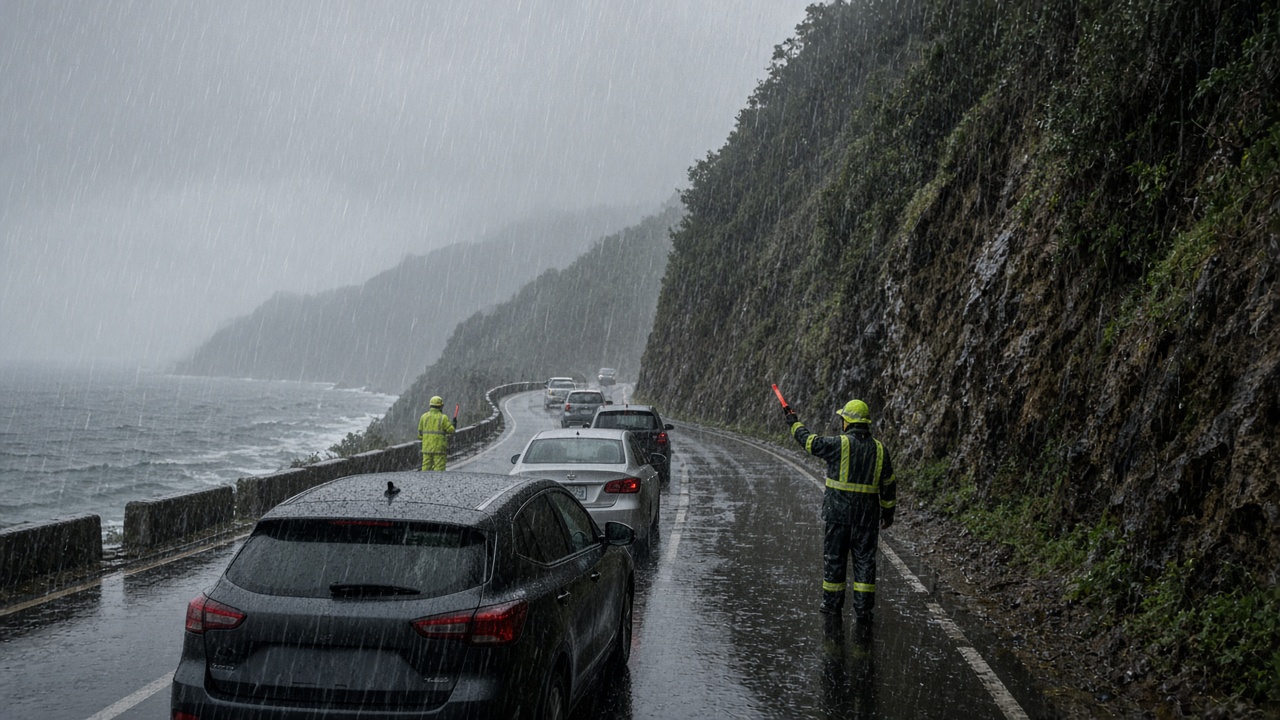
Japan's weather agency issued Level 5 landslide warnings — the most severe on its five-step scale — for Niijima and Oshima in Tokyo's Izu island chain on Friday as record rainfall drenched the capital region and eastern Japan.
The Japan Meteorological Agency said intense rain bands parked over the Kanto plain, swelling rivers and soaking slopes already weakened by days of downpours. Authorities urged residents in vulnerable areas, especially near cliffs and ravines, to move to safer ground immediately rather than wait for visible mud movement.
Disruption across Kanto
Train operators reduced service on major commuter lines in Tokyo, Chiba and Kanagawa prefectures as flooding blocked roads and water pooled in low-lying districts. Schools in several prefectures suspended classes, and municipal offices opened shelters for people who could not stay in hillside homes overnight.
On the Izu islands, ferry schedules were trimmed and local governments broadcast repeated alerts through loudspeakers and disaster apps. Fire departments reported multiple calls for flooded roads and stranded drivers, though early Friday there were no confirmed fatalities tied to the Level 5 designation itself.
What officials expect next
Forecasters warned that even after the heaviest cells move north toward Fukushima and other Pacific coast areas, landslides can follow hours later when soil remains saturated. The agency said another concentration of rain clouds could develop across Kanto and the Izu chain through Monday night, keeping emergency teams on standby.
Prime Minister Sanae Takaichi's government has faced parallel pressure on disaster readiness after a string of summer heat and typhoon events; Friday's alerts tested municipal evacuation messaging in dense Tokyo suburbs as well as on remote islands administratively part of the capital.
How Level 5 differs from lower alerts
Level 5 warnings, rare in urban-adjacent jurisdictions, tell residents that survival may depend on leaving before a slope fails. Lower levels recommend preparation or voluntary evacuation. The JMA paired the island alerts with river flood warnings in several Kanto watersheds, asking people to avoid nonessential travel until operators restore full rail timetables.
Utility crews inspected transmission lines in wind-exposed coastal sections of the Izu chain, and mobile carriers reported brief congestion on disaster information sites as users refreshed radar maps. Officials asked hikers to postpone trips to the islands until the agency downgrades the alert.
Tokyo Governor Yuriko Koike's office said metropolitan disaster headquarters would remain staffed through the weekend, coordinating with island mayors who maintain fewer permanent shelters than mainland wards. Past typhoons have stranded tourists on Oshima when ferries cancel; Friday's warnings included English-language posts on the Tokyo disaster portal for visitors who might not follow Japanese television tickers.
Insurance industry groups reminded homeowners that standard fire policies do not cover mudslide damage unless riders are purchased, a gap that surfaced after earlier Kanto cloudbursts. The land ministry said it would dispatch geologists to inspect known slide paths on Niijima once rain rates fall below critical thresholds, a process that can take 48 hours even after skies clear.