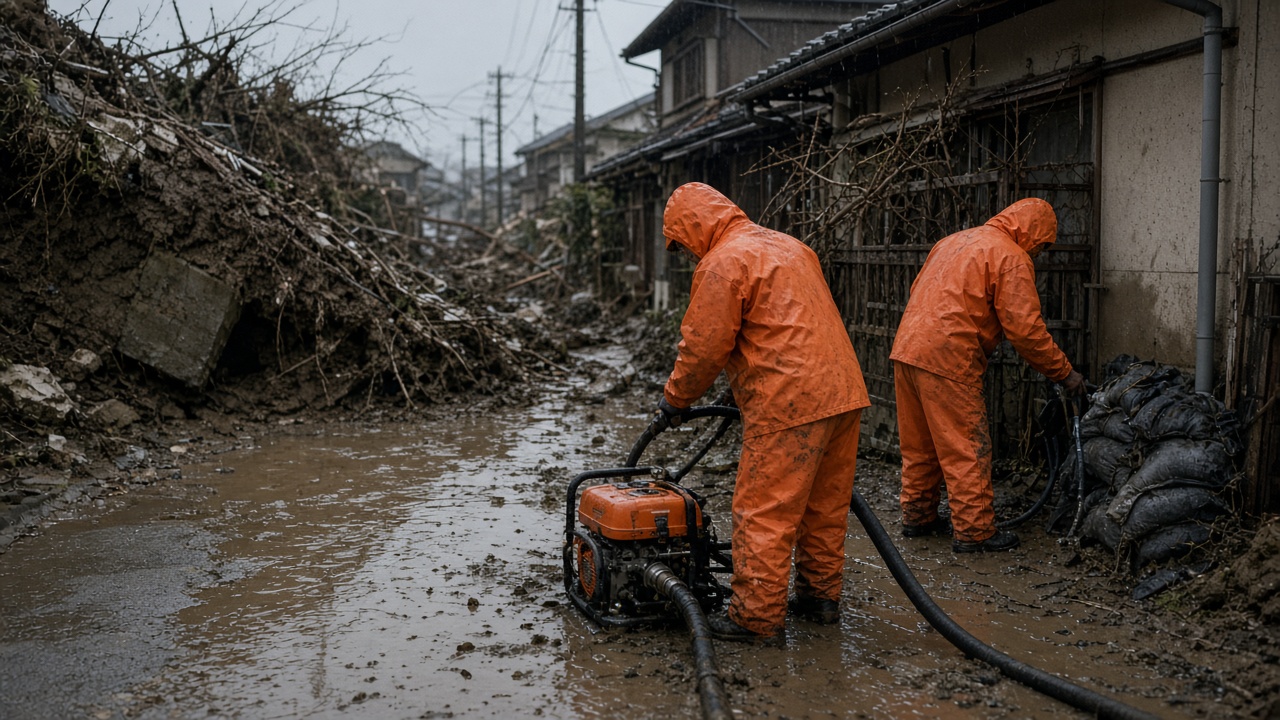
A national emergency team began 24-hour drainage work Thursday at a flooded housing estate in Sakurai, Chiba Prefecture, where Typhoon No. 25 left water nearly a metre deep more than two weeks after the storm passed.
The Ministry of Land, Infrastructure, Transport and Tourism dispatched TEC-FORCE — its rapid disaster-response unit — to the Kaiun housing complex after a landslide from an embankment collapse blocked drainage channels on 21 September. As of 7 October, the town measured flood depth at 95 centimetres even as local firefighters pumped water toward the Takasaki River from the south.
What blocked the neighbourhood
Officials said four separate embankment failures choked waterways near the estate. Thirteen of 27 households were inundated; 11 households with 23 residents remained in evacuation shelters this week, according to accounts carried by NTV and the Mainichi Shimbun via Yahoo News.
Sakurai Mayor Gakuto Kanazuka told reporters on 8 October that he had initially expected drainage could take about three months, but national crews might compress that timeline. Workers had been clearing vegetation and building access roads for additional pump trucks since 6 October.
The collapse site sits on soft ground with roughly 20 metres of elevation change, the mayor said, warning that further rain could trigger additional slips and slow progress.
Broader Chiba recovery
Chiba remains in a wider recovery from Typhoon No. 25 and earlier record rainfall. TEPCO Power Grid reported scattered outages still affecting hundreds of homes in the prefecture on 9 October, while bottled-water distribution continued at evacuation hubs in municipalities where mains remain unreliable.
Separately, a joint prefectural and national “Team Inbanuma” is draining farmland and homes after levee breaches at Lake Inbanuma sent water across northern Chiba. Infrastructure Minister Tatsunori Ibayashi told reporters Friday that emergency repairs and pumping around the lake were targeting completion within about a week as another typhoon approached the region.
What residents face next
At Kaiun, national teams are pumping from the north side of the complex while local crews maintain southern lines to the river. Town officials said donations through furusato nozei tax programs had raised about 1.2 million yen for disaster support and appealed for continued contributions.
For households still in shelters, the immediate question is when pumps can lower water enough to inspect foundations and utilities. Until channels are cleared and slopes stabilised, officials said, residents cannot safely return even if central Chiba’s headline outage numbers continue to fall.
Prefectural disaster officials said they would publish daily water-depth readings at Kaiun and coordinate with TEC-FORCE on whether additional pump capacity is needed if another storm approaches. Volunteers continued to deliver hot meals to shelters while town staff fielded calls from residents asking when utility crews could enter garages still submerged below knee level.