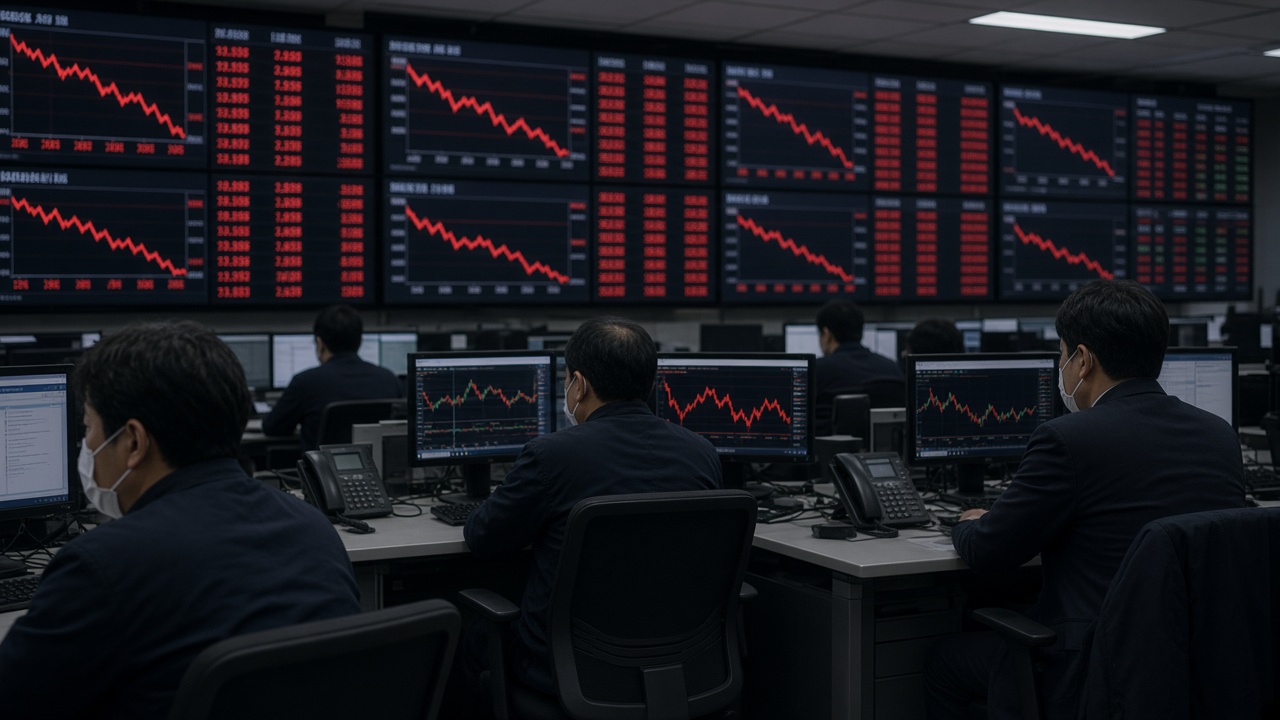
South Korea’s KOSPI shed 348.89 points, or 5.46 percent, on Tuesday to close at 6,035.35 after foreign investors unloaded 4.52 trillion won of shares and the Korea Exchange triggered a morning sell-side sidecar when losses breached five percent. Samsung Electronics and SK hynix led the slide as traders priced in stiffer competition from China’s ChangXin Memory Technologies and worries that the AI trade is losing momentum ahead of U.S. inflation data.
A session that broke the 6,000 line
The benchmark opened more than three percent lower and never recovered its footing. At 9:47 a.m., the exchange activated a sidecar that temporarily blocks program sell orders when the index falls at least five percent for a minute, the first such halt since August 19. Even with the pause, the KOSPI slid to an intraday low of 5,911.11 around 10:25 a.m., dipping below the psychologically important 6,000 threshold for the first time in about two and a half months before trimming losses into the close.
Foreigners accounted for the bulk of the pressure, extending a six-day selling streak that analysts at Kiwoom Securities and other brokerages linked to profit-taking after the index slipped under its 200-day moving average. Institutions also sold into the weakness, while retail buyers provided only a partial cushion near the bell.
Chip heavyweights drive the tape
Samsung Electronics fell 7.39 percent to 232,000 won and SK hynix dropped 10.09 percent to 1.44 million won, wiping out billions of dollars of market value in Seoul’s two largest weights. The moves followed reports that CXMT, a Chinese memory maker, is preparing higher-capacity DRAM aimed at servers, reviving fears that the supply discipline that lifted Korean margins this year could erode.
Securities researchers also cited the end of buyback programs at Samsung and SK hynix, which had been absorbing shares during the recent rally, and concerns about OpenAI’s revenue outlook after a volatile U.S. tech session. The won weakened to about 1,436 per dollar as exporters hedged and global funds trimmed Korea exposure.
What Seoul traders watch next
With total KOSPI market capitalization slipping back under five quadrillion won after five consecutive down days, portfolio managers said they need clearer signals from U.S. consumer price data and from Korean exporters’ fourth-quarter guidance before re-risking. A sidecar pause can cool automated selling, but it cannot reverse a fundamental reassessment of memory pricing power.
Unless Samsung and SK hynix reassure investors on capital returns or Chinese rivals delay product launches, Seoul’s benchmark may keep trading as a leveraged bet on AI infrastructure rather than a broad economy barometer—meaning another foreign outflow day could quickly retest the 5,900 zone even after Tuesday’s late recovery.