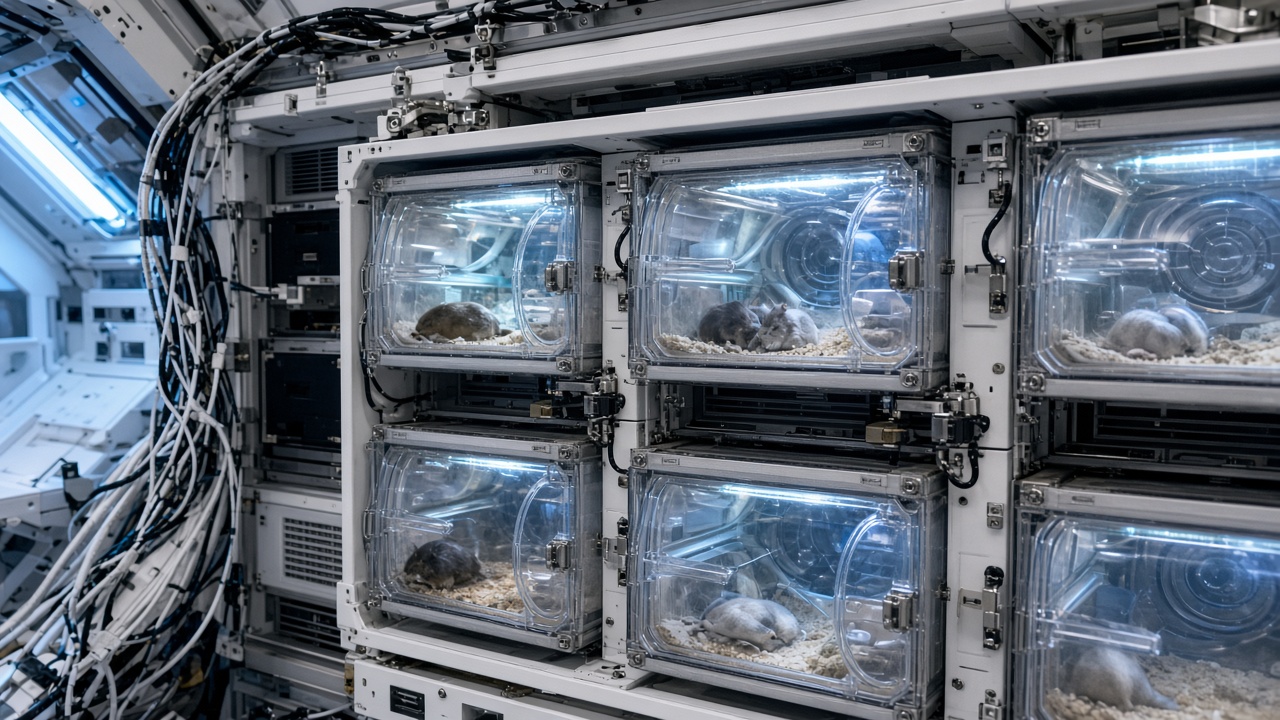
Mice raised inside the International Space Station’s Japanese Kibo laboratory showed stronger gastric acid secretion in microgravity than counterparts kept in artificial one-gravity or ground cages, according to a paper published in Acta Astronautica that JAXA highlighted this month.
Hardware details
Rodent habitats aboard Kibo include carbon dioxide scrubbers, automated watering and camera feeds monitored from Tsukuba Space Center. Technicians package tissue on return flights within hours to limit degradation, a logistics chain Japanese scientists have refined across multiple mouse missions since 2010.
Experiment design
The mouse sample share project compared three environments: true microgravity aboard Kibo, an onboard centrifuge simulating Earth gravity, and ground controls. Pathologists examined stomach tissue after return, focusing on parietal cells that pump acid and mucous glands that protect the lining.
Lead author Hiroki Bochimoto, now at JAXA, conducted the work while affiliated with Obihiro University of Agriculture and Veterinary Medicine. Co-authors spanned Japanese universities and space-life-science institutes.
Key finding
Only microgravity mice showed activated acid-secreting cells and post-secretion damage patterns in the gastric wall. Animals in artificial 1G aboard the station resembled ground controls, suggesting the effect is gravity-specific rather than launch stress alone.
The team argues the result aligns with anecdotal reports that astronauts experience digestive discomfort early in flight.
Human relevance
Researchers caution against direct human extrapolation—mouse metabolism differs—but the work feeds JAXA’s planning for longer lunar stays. Countermeasures might include diet tweaks, acid suppressants or exercise regimens timed to sleep cycles.
Private space-tourism firms with Japanese passengers may eventually need medical briefings drawn from this literature.
Program context
Kibo remains Japan’s primary paid payload for biology after retirement of the HTV cargo craft; Dragon and Cygnus resupply missions still deliver rodents under NASA-JAXA agreements. Sample-share programs let secondary labs request tissue slices, accelerating papers like this one.
Funding and follow-ons
JAXA’s human spaceflight budget faces parliamentary scrutiny as MMX Mars-moon launch approaches, but life-science lines often survive because of pharmaceutical partnerships. Drugmakers watch space-induced organ changes as stress tests for osteoporosis and muscle-wasting therapies.
A follow-up experiment could test whether probiotics or modified feeding schedules blunt acid activation.
Peer reviewers asked for longer observation windows; the team may propose a 90-day rodent mission if cargo mass allowances on resupply flights increase.
Bottom line
Kibo mouse data published in Acta Astronautica link microgravity to heightened gastric acid activity, giving Japan’s space agency experimental backing for digestive health planning on future long-duration missions.