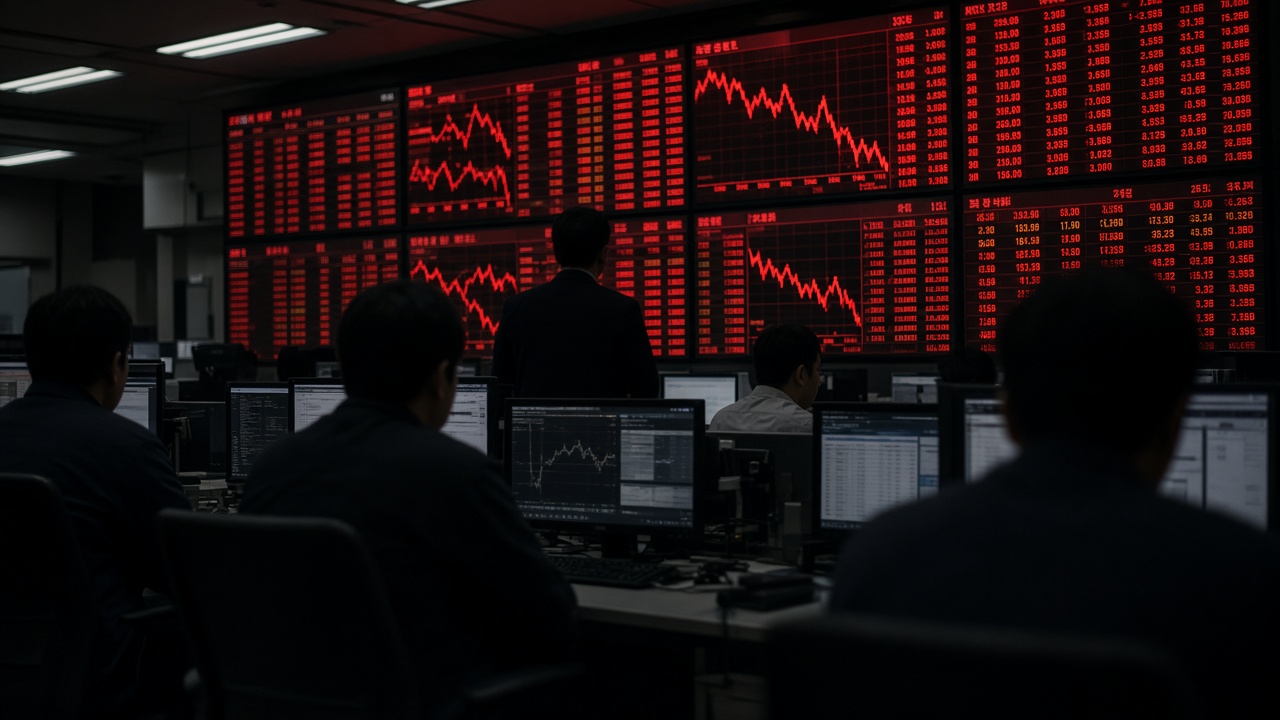
South Korea’s stock exchange halted KOSPI trading for 20 minutes on Thursday afternoon after the benchmark index fell more than 8 percent from the previous close, the ninth circuit-breaker activation this year and the first since late July. The pause began at 12:38 p.m. as a wave of selling in semiconductor names overwhelmed the broader market.
When the session ended, the KOSPI stood at 5,554.22, down 454.59 points or 7.57 percent—its lowest close in six months and a seventh straight losing day. Yonhap News Agency said the rout extended a global tech unwind tied to sticky U.S. consumer inflation and renewed doubts about the durability of artificial-intelligence spending.
Chipmakers lead the drop
Samsung Electronics shares fell 9.5 percent and SK Hynix lost 11.1 percent, according to market data cited by Reuters, after the Philadelphia semiconductor index slid overnight. Foreign investors were net sellers of roughly 3.6 trillion won in shares, extending an eight-day streak of outflows, while domestic institutions and retail traders stepped in with net purchases of about 1.69 trillion won and 1.29 trillion won respectively.
Trading had already been volatile earlier in the day. A sell-side sidecar—a separate volatility control—triggered shortly after the open when KOSPI 200 futures fell at least 5 percent within a minute, marking the 27th such activation in 2026, the Korea Times reported. Together, the sidecar and the Level-One breaker underscored how quickly sentiment shifted once inflation figures revived talk of further U.S. rate increases.
Authorities respond
Financial regulators convened an emergency meeting to review market conditions and pledged proactive steps to protect investors, according to accounts from the session. Bond markets offered a partial counterweight: the three-year Korean treasury yield eased slightly even as equities sold off, suggesting some repositioning toward safer assets within Korea.
Analysts on Seoul trading desks said the move was less about a single domestic catalyst than a repricing of global tech risk. “The tape was already fragile after a run of foreign selling,” one strategist at a mid-sized brokerage said by phone, asking not to be named because the firm had not published formal research. “Once Samsung and Hynix broke support levels, the breaker was almost mechanical.”
What traders watch now
Market participants said attention would shift to U.S. Federal Reserve commentary and earnings guidance from memory-chip suppliers. With leveraged single-stock products still prominent in Korean retail flows, regulators may face pressure to revisit volatility tools if outsized moves persist.
For now, the midday halt gave desks a breather—but not a reversal. When trading resumed, the index remained deep in the red, and traders braced for another volatile Friday session across Asia as investors reassess how much of the AI build-out is already priced into Seoul’s largest listings.