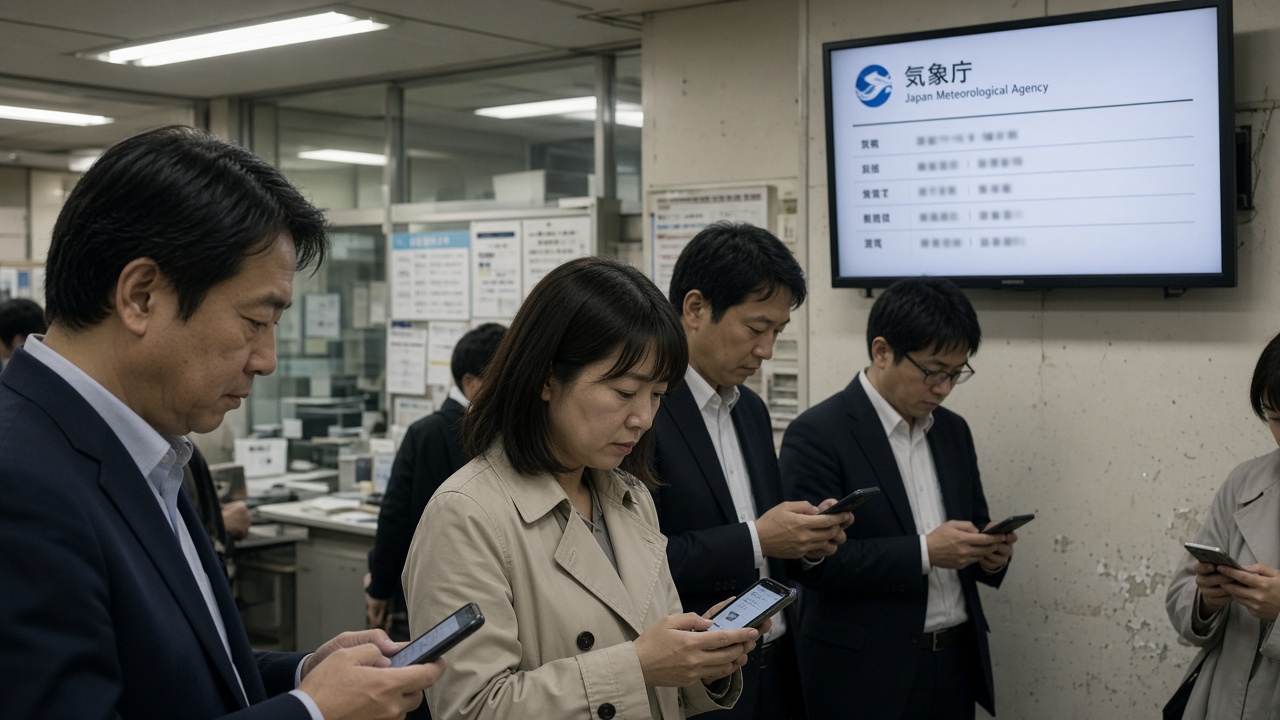
A magnitude-6.9 earthquake off Russia’s Kamchatka Peninsula triggered Japan’s emergency earthquake warning system on Friday, but the alert was withdrawn within minutes after analysts realized the automated magnitude estimate had overshot to 9.9. The Japan Meteorological Agency said it is reviewing how the false reading propagated from Hokkaido to central Honshu even though ground shaking remained light and no tsunami was expected.
How the alert unfolded
According to the agency and broadcasters including TV Asahi, the offshore quake struck at 12:38 p.m. Japan time at a depth of about 160 kilometers. Instruments recorded only intensity 1 shaking in Hakodate, yet the Earthquake Early Warning network still pushed a “strong shaking expected” message to millions of phones from Hokkaido through the Kanto region.
At 12:48 p.m., roughly ten minutes after the initial bulletin, the agency canceled the warning. Meteorological officials told reporters the agency had not been hit by a cyberattack and that nuclear plants proceeded under standard checks. No injuries or damage were reported in Japan.
Why the magnitude jumped
Meteorological officials scheduled an afternoon press conference to explain why the system’s first pass produced a magnitude-9.9 figure, a reading Nippon TV said was “excessive.” Early warnings rely on the first seconds of seismic data; distant, deep events can be mis-sized before additional stations refine the calculation.
Still, the overshoot was unusually large for a quake that barely rattled furniture in northern ports. Railway companies said they briefly held trains per protocol, and construction sites from Sapporo to Tokyo reported automatic pauses while workers waited for the all-clear.
Mobile carriers said SMS gateways handled a spike in simultaneous alerts without crashing, but customer-service lines lit up with questions about whether elevators would restart automatically. Universities from Sendai to Nagoya briefly halted experiments involving hazardous chemicals until shaking thresholds were confirmed at zero.
Seismologists outside government noted that Friday’s quake sat on the same Pacific ring segment that produced large events in 1952, yet the depth and distance meant almost no perceptible motion in Tokyo skyscrapers. They urged the agency to publish the raw waveform that produced the 9.9 estimate so outside labs can replicate the error.
Public trust on the line
Japan built the world’s most aggressive early-warning network after the 2011 Tohoku disaster, and false alarms are rare enough that each one becomes a national conversation. Friday’s episode arrived days after municipalities restarted disaster-alert services supplied by IT vendor Arcadia following a separate unauthorized-access incident that disrupted municipal messaging.
Opposition lawmakers asked whether redundant checks are needed before megacity populations receive phone buzzes, while scientists cautioned against disabling the system entirely. The meteorological agency pledged to publish a timeline once its internal review finishes, and prefectural governments urged residents to keep alert apps enabled despite the scare.