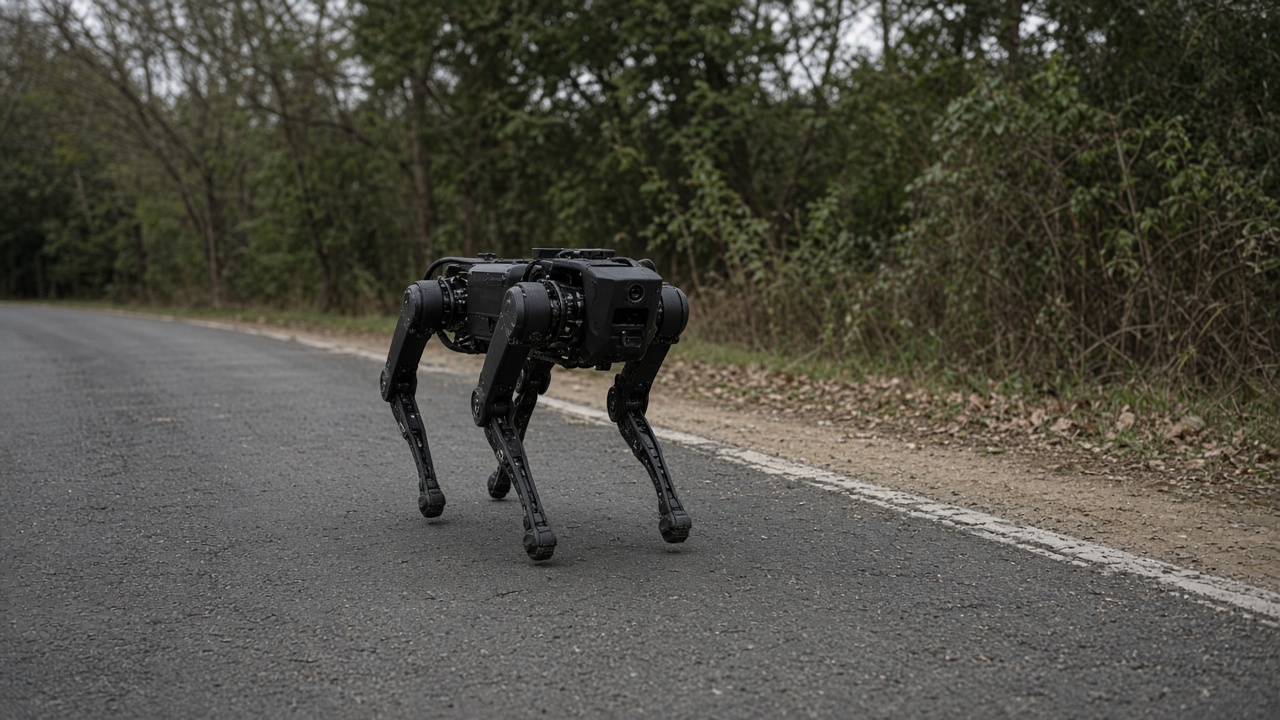
A KAIST-led team said its RAIBO2 quadruped robot completed a regulation marathon distance in 4 hours, 19 minutes, and 52 seconds on a single battery charge, a endurance result published in Nature that highlights how hardware and control co-design can stretch legged robots beyond lab demos.
Engineering choices
Unlike wheeled platforms, legged machines bleed energy supporting body weight and recovering from foot impacts. The RAIBO2 team modeled those losses jointly, then built lighter leg mechanisms, low-resistance motor drivers, and a gait policy that minimizes wasted motion.
The robot achieved a transport cost of 0.25, below the 0.37 benchmark cited for efficient human running, and reportedly tripled the range of prior quadrupeds on comparable batteries.
Why it matters beyond sport
Marathon-scale endurance is a proxy for disaster response and inspection jobs that require hours of walking across rubble or factory floors. KAIST noted remaining hurdles — faster actuators, better power density, and field testing — before commercial deployment.
South Korea's robotics sector often markets humanoids for publicity, but RAIBO2's result shows quadrupeds still win when the mission is simply to keep moving for tens of kilometers without swapping packs.
Lab to field gap
RAIBO2's marathon was conducted on a measured course with support crews, not in an unstructured city environment. Translating the result to firefighting or nuclear inspection requires dust, stairs, and radio dead zones that lab papers rarely capture.
KAIST collaborators said next steps include faster foot placement on uneven gravel and swappable battery modules for missions longer than 42 kilometers.
Industrial policy angle
Korea's Ministry of Trade, Industry and Energy has funded legged robots for disaster response since the 2020s. A Nature cover gives KAIST borrowed-money in upcoming budget hearings, especially as humanoid projects consume headlines and dollars.