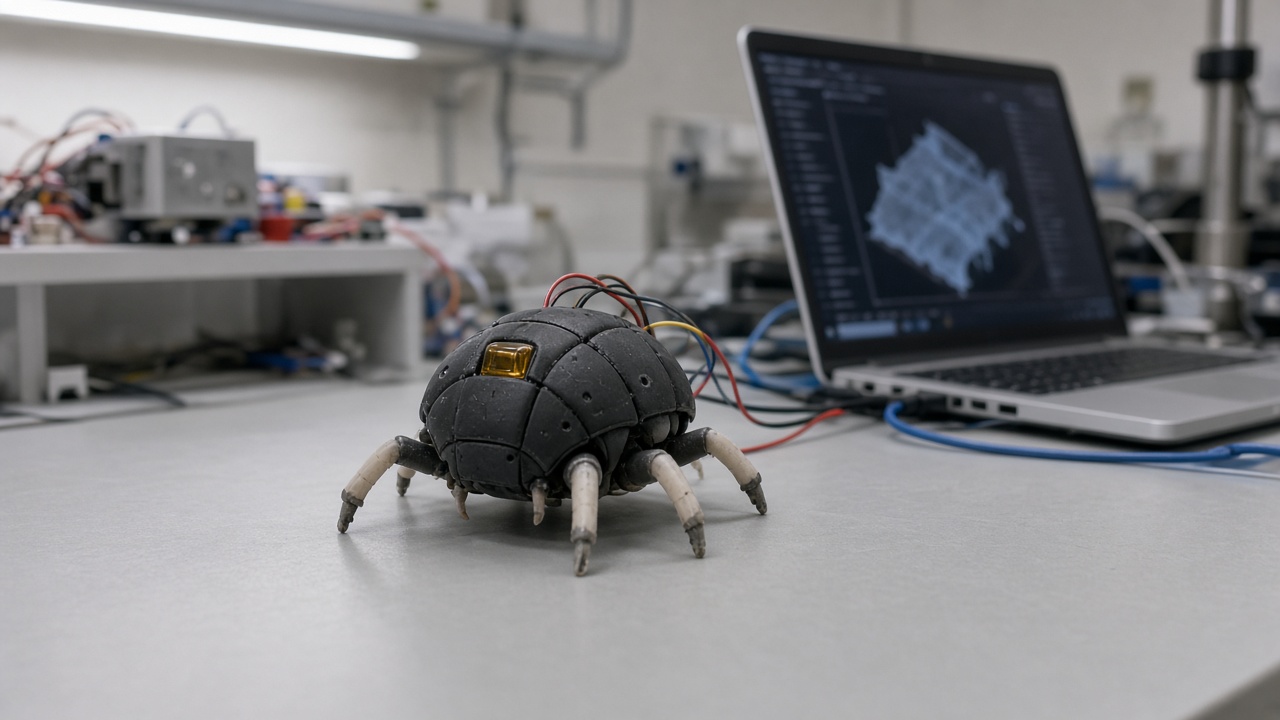
KAIST unveiled BeetleBot on October 13, a palm-sized soft robot that operators steer with finger bends while a camera and tactile skin feed force data back to a remote workstation.
How finger control maps to motion
Instead of a joystick, the pilot wears a sensor glove that reads knuckle angles. Small changes in bend translate into crawl speed and turning radius on the robot’s flexible chassis, which mimics beetle-like scutes. The design targets inspectors who need one hand free for notes or safety rails while guiding the bot through pipes or rubble gaps.
Seeing and feeling at a distance
BeetleBot carries a micro camera for live video and a distributed tactile layer that reports pressure spikes when the shell contacts obstacles. Researchers said combining sight and touch cuts false positives in teleoperation: a visual shadow that looks like a wall is confirmed or dismissed by a light tap reading. The team published the architecture in Science Advances on August 19, 2026, after bench tests on sand, gravel, and tiled floors.
Professor Sang Ouk Kim led the work at KAIST’s Department of Materials Science and Engineering, with collaborators at Caltech and Nanyang Technological University contributing simulation models for soft-body friction. The cross-lab split let Korea fabricate the silicone composite skin while U.S. and Singapore groups stress-tested control algorithms before the field demo.
Where a soft crawler fits
Industrial partners watching the announcement cited nuclear decommissioning corridors and ship-hull surveys as early use cases. Because the body deforms rather than shattering on impact, BeetleBot can wedge into irregular gaps that rigid drones skip. KAIST has not announced a commercial spinoff timeline, but patent filings cover both the glove mapping and the tactile mesh layout.
For robotics readers, the October demo is a data point in Korea’s push on soft machines: less metal exoskeleton, more graded materials that survive repeated collisions. The next test phase adds autonomous segments so the glove supervises rather than micromanages every centimeter.
Lab video released with the announcement showed BeetleBot climbing a 35-degree foam incline while the operator adjusted only index and middle fingers. Latency between touch feedback and on-screen force maps stayed under 120 milliseconds on the campus test network, a figure the team wants to cut before field trials with firefighters. KAIST’s technology transfer office said licensing talks with two domestic robot integrators are underway, though no MOU signatures were disclosed at the press event.
Compared with wheeled inspection bots already deployed in Korean subway tunnels, BeetleBot trades speed for conformability. Maintenance crews said the soft shell is easier to rinse after chemical exposure, a small but practical advantage when decontamination minutes matter.
Funding for the prototype came from a Ministry of Science and ICT grant aimed at disaster-response robotics, part of a broader 2026 budget line that also backs drone mesh networks for mountain search. That public money requires open publication, which is why the August paper precedes the October hardware tour.