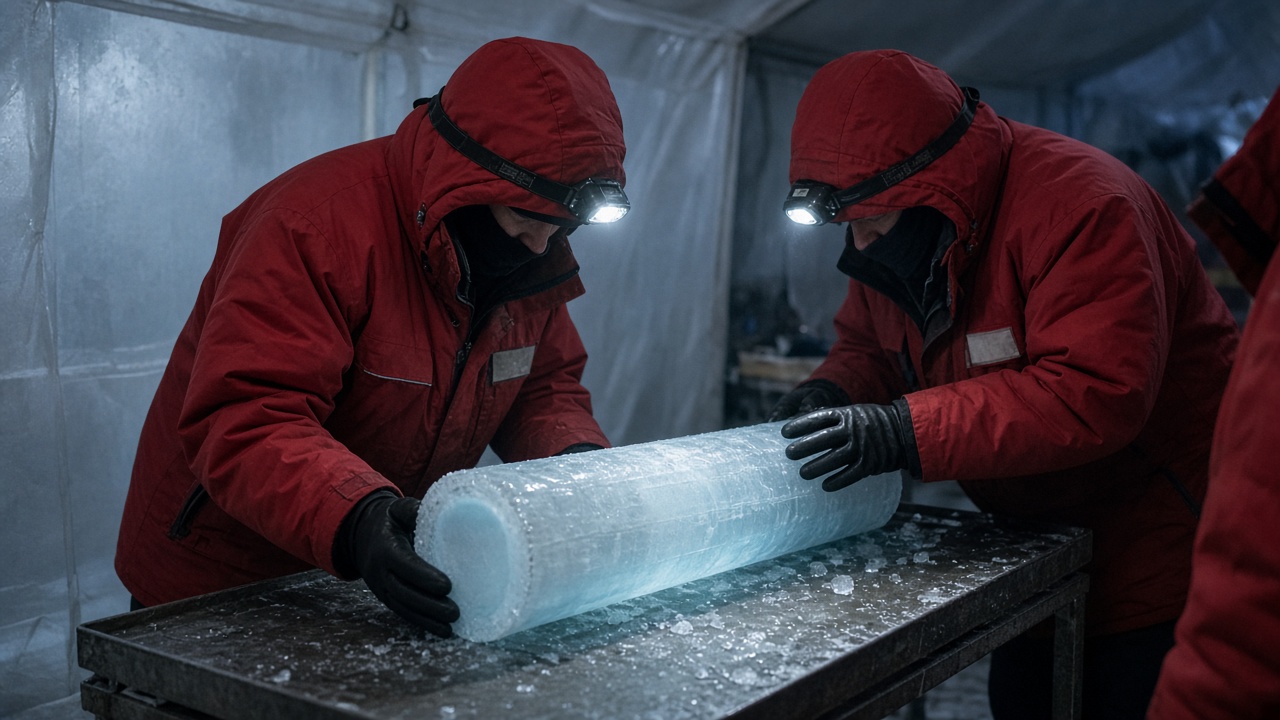
Researchers at the Korea Polar Research Institute logged the highest methane reading yet from a coastal Antarctic ice core drilled near Jang Bogo Station, publishing the measurement Wednesday ahead of a fuller study on how ancient thaw episodes might inform modern climate models.
The segment, taken at 162 meters depth, registered 1,987 parts per billion methane trapped in bubbles—about 12 percent above the previous Korean record from a 2019 core on the same ice rise. The team cautioned that a single spike needs replication across adjacent layers before scientists treat it as evidence of a rapid release event rather than a local anomaly.
Drilling season logistics
The core was extracted in January during the austral summer campaign when KOPRI’s icebreaker Araon resupplied Jang Bogo. Engineers used a electromechanical drill that preserves gas pockets better than thermal melting, shipping cylinders frozen at minus 25 Celsius to Incheon’s cold lab for analysis with a cavity ring-down spectrometer.
Lead author Park Min-ho said the reading aligns with other institutes’ findings that West Antarctic coastal ice can preserve abrupt methane signals from marine sediments when grounding lines retreated during past warm periods. The institute plans to submit paired isotope data next month to separate biogenic methane from thermogenic sources.
Policy reception
The Ministry of Oceans and Fisheries, which funds KOPRI, highlighted the result in a parliamentary briefing on polar science budgets, arguing Korea needs continued ice-core access as international treaties renegotiate Antarctic logistics permits. Opposition members asked whether the finding changes Korea’s domestic methane reduction targets; scientists answered that paleo records inform models but do not replace emissions inventories from agriculture and energy.
What comes next
KOPRI will return to the site in the 2026–2027 season to drill a parallel hole five meters upslope, a standard replication step before publishing in a peer-reviewed journal. Collaborative labs in France and Japan have requested split samples under existing memorandums of understanding.
For readers far from Antarctica, the takeaway is narrower but concrete: Korea’s polar program is producing measurable data, not just flag planting. Whether this methane spike becomes a chapter in climate textbooks depends on the next core, not today’s headline number.
International collaboration
KOPRI invited British Antarctic Survey researchers to compare gas chromatography methods during a May workshop in Incheon, reducing the risk that instrument calibration—not climate history—produced the spike. Ship time on the Araon for the replication hole is already budgeted in the 2027 polar bill.
Industry groups and regulators said they will publish follow-up guidance within two weeks, giving banks, shippers, and clinics time to adjust internal checklists before year-end audits. Consumer advocates asked for plain-language summaries on issuer websites so cardholders and patients understand what changes on their next statement or visit.
Analysts covering the sector said the announcement fits a broader pattern of tighter operational rules after a string of high-profile compliance and safety cases this autumn. Whether the move shifts fundamentals or simply clears near-term compliance backlogs will depend on enforcement data due out in January.