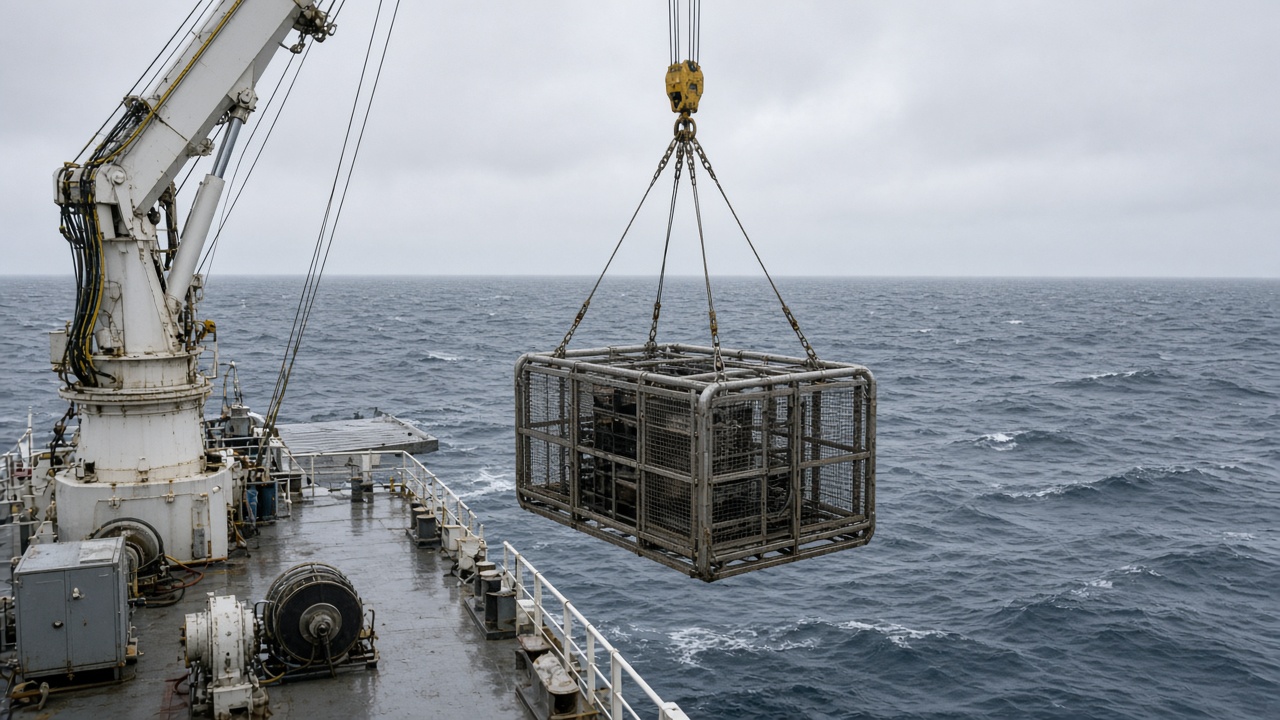
Researchers aboard the Japan Agency for Marine-Earth Science and Technology vessel Kaimei recovered manganese nodule samples from 5,400 meters depth east of Minami-Tori Shima, the agency said Monday. The haul gives geochemists fresh material to estimate cobalt and nickel grades as Japan prepares for International Seabed Authority negotiations on commercial mining permits.
What the crew collected
Using a remotely operated vehicle, the team boxed 18 kilograms of nodules from a 2-by-2 kilometer survey grid. Onboard X-ray fluorescence scans showed variable manganese coatings, with nickel content averaging 1.1 percent by dry weight in the first dozen samples—within ranges JAMSTEC reported from a 2023 cruise but higher in two boxes taken near a previously unmapped ridge.
Scientists also mounted temperature and turbidity loggers that will stay on the seabed for six months to watch whether sediment plumes from future mining could travel toward the protected Minami-Tori Shima coral zone 400 kilometers west.
Policy context
METI funds deep-sea resource surveys as part of a broader critical-minerals strategy that includes recycling and Australian lithium imports. Environmental groups in Tokyo petitioned the agency last month to pause extraction talks until biodiversity baselines exist; JAMSTEC’s cruise is partly a response, producing open-data maps within 90 days.
Commercial miners such as Nauru-backed The Metals Co. are not involved in this science leg; JAMSTEC stressed the voyage was public research, not a test mining run.
Lab work ahead
Shore teams at Yokosuka will leach nodules for cobalt and rare-earth assays using low-acid protocols JAMSTEC developed with Tohoku University. Results feed a public database the agency promised ISA delegates at the July Kingston meeting.
Environmental monitoring
Deep-sea cameras recorded sea cucumber and brittle star densities near the sample site; biologists will compare footage to 2021 baselines. Conservation NGOs say six months of logger data are insufficient, but JAMSTEC argues it is a start before any contractor applies for a test mine.
Industry interest
Trading house Sojitz Corp. holds a minority stake in a seabed exploration venture but was not aboard this cruise. METI lists deep-sea minerals as optional, not mandatory, in Japan’s 2026 critical minerals plan.
International law
ISA delegates meet again in November to debate a mining code; Japan’s delegation will cite JAMSTEC sediment logger data as evidence that plume monitoring is feasible before commercial extraction. Australia and Canada support similar science-first delays.