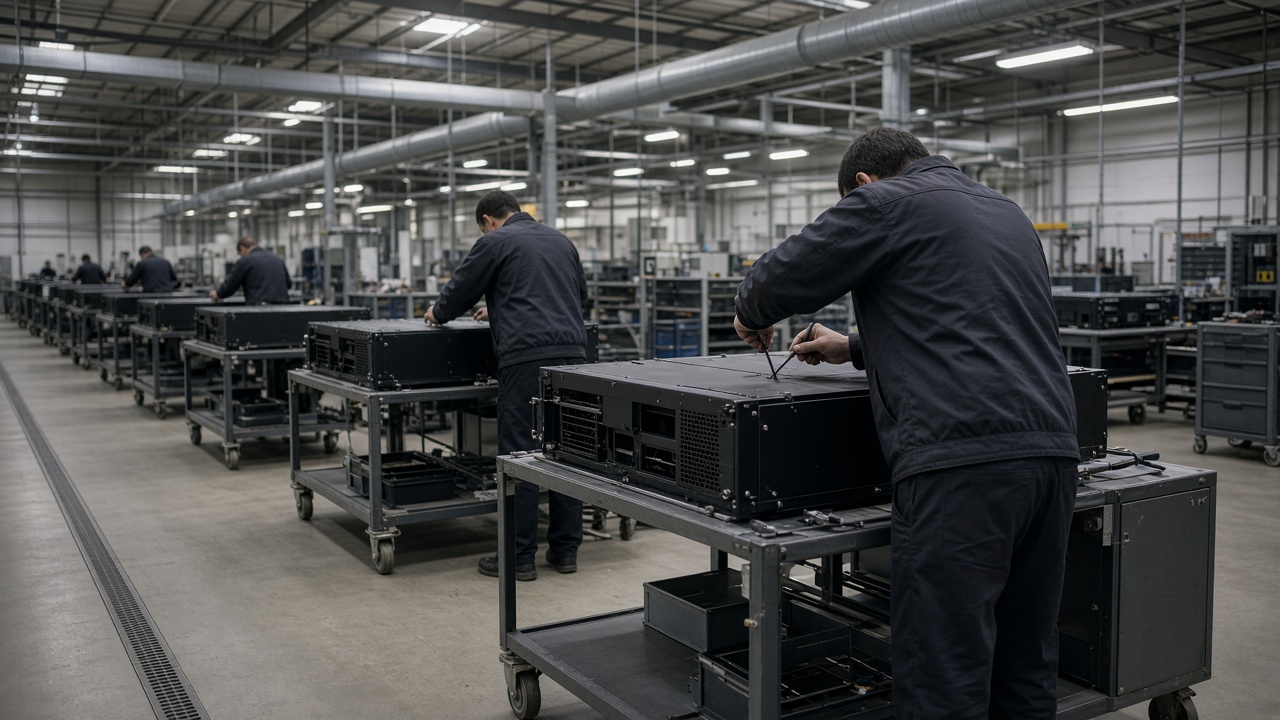
Taiwan’s server original design manufacturers entered a critical U.S. earnings week with order books tied to hyperscaler capital spending plans that brokers now estimate could approach US$1.3 trillion in 2026, up sharply from roughly US$800 billion this year. Quanta Computer, Wistron and Inventec shares steadied Tuesday as investors awaited Microsoft and Alphabet results for explicit rack deployment timelines.
Why earnings matter more than GDP
First-quarter guidance from U.S. cloud providers sets the tone for Taiwan assembly lines that build AI racks, cooling manifolds, and power shelves. Domestic strategists told clients that a single percentage-point change in stated capex growth can swing monthly revenue at top ODMs by double-digit millions of U.S. dollars. With the Philadelphia semiconductor index recovering, funds are willing to hold Taiwan AI hardware into prints—but not to add aggressively without management commentary.
Supply chain positioning
ODM purchase orders for graphics processing unit servers remain backlogged into early 2027, according to two component distributors briefed by manufacturers. Memory and networking cards remain gating items, echoing TSMC’s third-quarter remark that advanced-node demand is “supported by strong AI and HPC.” Any sign that customers are slowing custom accelerator programs would hit ODM margins before it appears in foundry wafer starts.
Competition and pricing
U.S. brands increasingly split builds between Taiwanese ODMs and in-house integration teams, pressuring pricing on standard 2U GPU chassis. Quanta’s enterprise segment has emphasized liquid-cooled designs with higher engineering fees, while Wistron highlights North American footprint expansion to reduce tariff risk. Investors compare gross margin trends across these strategies each quarter; this week’s focus is forward demand, not last quarter’s assembly yields.
Macro crosswinds
Federal Reserve decisions and U.S. election uncertainty have not canceled projects, but they delay purchase-order releases at the margin. ODM CFOs on recent calls said customers are signing shorter option windows, forcing factories to keep flexible capacity on standby. That flexibility costs money, which is why earnings-driven capex affirmations matter for working capital.
Local ecosystem effects
Rack builds pull in power supplies, optics, and substrate vendors across Taiwan. A strong cloud print would reinforce Tuesday’s optical rebound and stabilize PCB houses that suffered during last week’s tech selloff. Weak commentary would likely trigger another round of foreign sales concentrated in high-beta AI names, even if TSMC fundamentals remain intact.
Investor playbook
Funds are running scenario analysis: bullish prints could add 3–5 percent to leading ODM shares in Taipei; cautious language may erase Monday’s futures-driven gains. Traders advised using earnings volatility to adjust exposure rather than chase overnight gaps, because Taiwan’s session often fades U.S. enthusiasm when ADR premiums compress.
On the ground
Shift supervisors at Taoyuan and New Taipei plants report overtime caps lifted for November builds tied to U.S. data-center expansions. If earnings confirm those schedules, hiring fairs for assembly technicians will resume; if not, temporary workers hired after the typhoon week may see contracts cut early.
Component lead times
Power shelf and busbar lead times remain elongated, forcing ODMs to stage partial racks while awaiting copper and connector shipments. Procurement teams meet weekly with metal suppliers to prioritize AI SKUs over legacy enterprise orders, a triage process that can delay non-AI customers without canceling programs outright.
Sustainability reporting
Large ODMs face new disclosure rules on data-center energy intensity per shipped rack. Environmental teams work with U.S. customers to document liquid-cooling adoption, a paperwork burden that nonetheless supports premium pricing on advanced designs.
Historical context
During the 2023–2024 AI build cycle, ODM shares re-rated before earnings confirmed rack shipments, then consolidated when customer concentration risks surfaced. Portfolio managers said they are unwilling to repeat that pattern without hearing 2027 deployment schedules articulated on calls, not just in sell-side models.
Taiwan labor market
Assembly wages rose after the typhoon week as plants offered retention bonuses to technicians who worked through generator tests. Labor costs remain a smaller share of rack bill of materials than GPUs, but executives highlight them on calls when explaining margin ceilings.