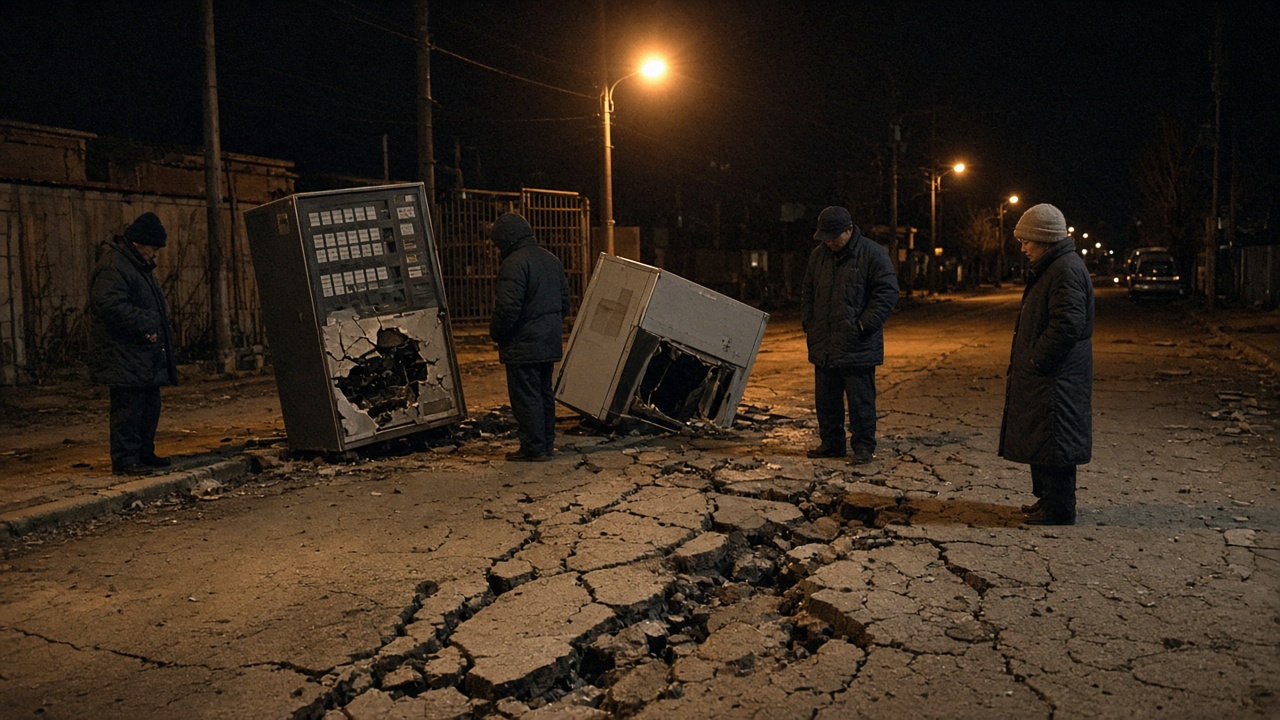
A magnitude 5.7 earthquake centered in western Shizuoka Prefecture struck at 1:04 a.m. on Sunday, rattling a wide swath of central Japan and producing upper-5 intensity on the Japanese seven-step scale in Chita City, Aichi Prefecture—the strongest shaking there since March 1997, according to the Japan Meteorological Agency.
Authorities said there was no tsunami threat. Nonetheless, the predawn jolt injured multiple people, disrupted water supplies in at least one Aichi town, and prompted Prime Minister Shigeru Ishiba’s government to open a liaison room at the crisis management center in Tokyo less than three minutes after the main shock.
Where the shaking landed
The agency placed the hypocenter in western Shizuoka at a depth of 41 kilometers, revising an earlier rapid estimate. Lower-5 shaking was recorded across parts of Aichi, Shizuoka, Gifu, and Nagano prefectures. In Shizuoka itself, Hamamatsu logged lower-5 intensity, while coastal communities reported cracked roads and frightened residents climbing out of bed as furniture slid.
Because the quake originated inside the Philippine Sea plate, officials described the faulting as tensional. That mechanism differs from the slow megathrust slip feared along the Nankai Trough, and the agency said Sunday’s event alone does not prove a change in plate coupling along that hazardous zone. Engineers at Chubu Electric Power Co. reported no abnormalities at the Hamaoka nuclear plant on the Shizuoka coast, a perennial focus whenever the region shakes.
Injuries and infrastructure
Fire departments across Aichi and Shizuoka tallied dozens of ambulance calls by dawn. In Tokoname, a woman in her 50s fractured an ankle. Toyota City responders treated a man in his 40s and a woman in her 80s for head injuries after they fell during the shaking. NTV reported additional transports in Kakegawa, Iwata, and Mori—ranging from dislocated shoulders to dizziness after tumbles from bed.
In Higashiura Town, officials said parts of the municipal water network lost pressure and that crews fielded reports of water jetting from manholes. JR Central halted an overnight sleeper train between Takatsuka and Maisaka on the Tokaido Line while inspectors walked the tracks. Expressway operators said the Tomei and Shin-Tomei highways remained open.
Official guidance
At a 2:35 a.m. briefing, JMA executive Ebita Ayataka urged residents in the hardest-hit areas to watch for landslides and rockfalls, especially if rain follows. Historical statistics, he noted, show a 10–20 percent chance of a similarly strong aftershock within a week of a main shock of this size, with the next two to three days particularly active.
Because the epicenter lies inside the Nankai Trough’s notional zone, the agency reiterated that it will keep monitoring crustal strain even though Sunday’s rupture was too small to reset assumptions about a future megaquake. Town halls from Hamamatsu to Chita opened phone lines for elderly residents and set up temporary water trucks where service was cut.
What residents should expect
School officials in Chita said they would inspect campuses before Monday classes. Companies including Toyota, with plants in the lower-5 zone, began facility walk-throughs at first light. Local governments asked households to secure top-heavy furniture and keep emergency bags near exits while aftershocks continue.
For now, the event reads as a sharp reminder of central Japan’s seismic risk rather than a confirmed step toward a trough-wide rupture. Still, the upper-5 recordings in Chita—far from the Shizuoka epicenter—show how deep, moderate quakes can surprise population centers that have not felt comparable violence in a generation.