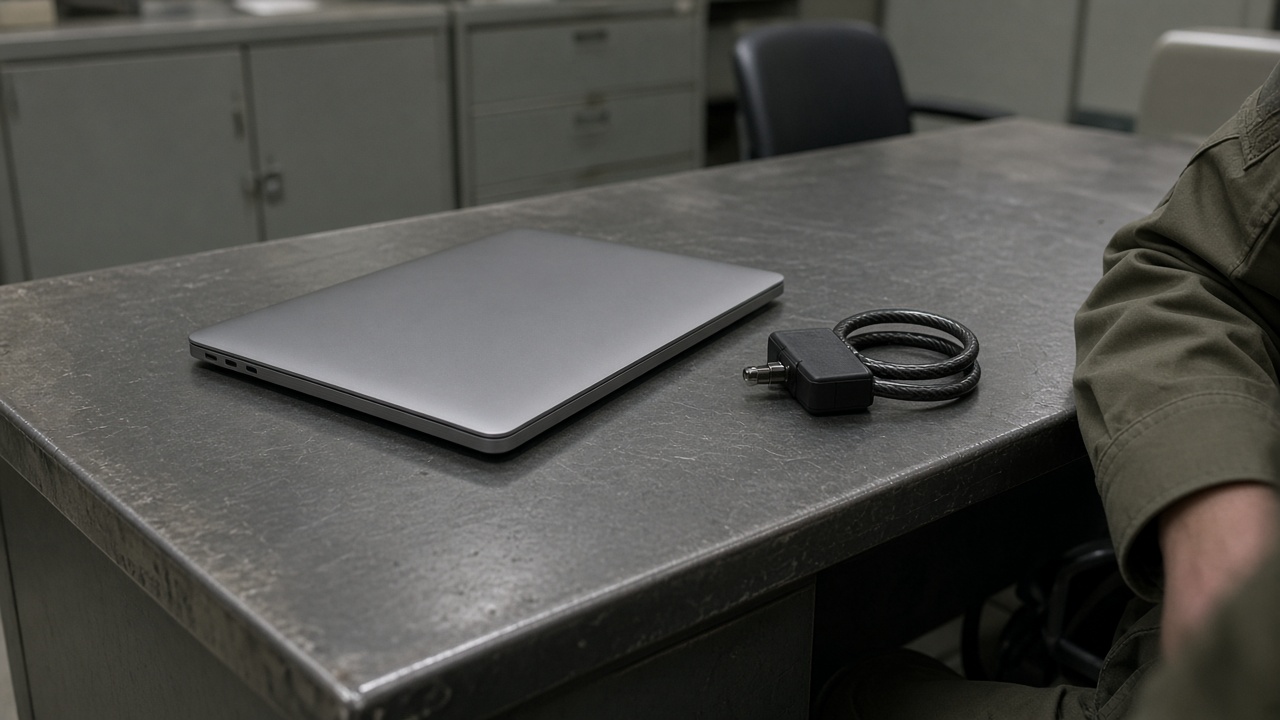
Apple began delivering MacBook Pro government configurations with on-device Apple Intelligence models preloaded on M5-series Neural Engines, matching what commercial buyers see on 2026 spec sheets while giving federal integrators a hardware path that keeps inference local. The shift collides immediately with Defense Information Systems Agency security baselines for macOS 26 Tahoe, which still require disabling Genmoji, Image Playground, Writing Tools, and Setup Assistant prompts that could route sensitive drafts toward cloud services.
What ships on the government SKU
Apple’s technical specifications describe Apple Intelligence as a personal intelligence system with privacy protections that prevent even Apple from accessing on-device data. Government configs emphasize the on-prem inference stack—summarization, rewriting, and coding assists that run without sending content to Apple servers when policies allow. M5 Pro and M5 Max options scale unified memory up to 128 gigabytes on paper, attractive for scientists who run proprietary modeling tools that Apple cannot host in iCloud.
The Naval Research Laboratory’s late-summer MacBook procurement illustrates demand: eleven brand-new 14- and 16-inch units with mandated macOS for Space Science Division workflows that cannot migrate to Windows without breaking instrument software chains. Authorized resellers must prove OEM warranty continuity—no gray-market kits—highlighting how even small science buys route through federal acquisition rules unrelated to AI marketing.
Where STIG guidance diverges
DISA’s macOS 26 STIG catalog treats several Apple Intelligence features as medium-to-high severity findings because they involve off-device AI creation paths. Administrators must disable Genmoji and Image Playground; Writing Tools that lean on cloud backends are out of policy on controlled networks. Setup Assistant prompts that nudge users toward enabling Apple Intelligence must be suppressed so fresh laptops do not opt-in before MDM baselines apply.
That creates a two-layer reality: hardware capable of local models, and configuration profiles that strip consumer-facing AI surfaces integrators fear will leak metadata or prompts. Apple’s government imaging partners say they deliver separate “science” and “administrative” bundles—one looser for unclassified lab VLANs, stricter for machines that might touch export-controlled data.
How integrators thread the needle
Systems engineers map Apple’s on-device features against NIST 800-53 controls the STIG inherits. Local summarization of PDFs on an air-gapped VLAN may pass if logging proves no egress; the same feature on a internet-connected procurement laptop may fail if Writing Tools can phone home. Mobile device management exports show which intelligence services remain enabled after hardening scripts run.
Science teams push back when STIG locks remove coding assistants that speed instrument script maintenance. Negotiations land on allow-lists for specific binaries and outbound firewall rules rather than blanket enablement—boring work that procurement officers rarely see but ISSOs demand.
Commercial parity and support costs
Government buyers pay for parity with Apple's retail story—Neural Engine throughput, battery life, nano-texture display options—while accepting that security engineering hours erase half the demo features shown in Apple Park keynotes. Help desks must document which tickets go to Apple enterprise support versus internal hardening teams when an OS point release re-enables a feature STIG thought it killed.
What program offices should decide early
Before signing statements of work, decide whether “Apple Intelligence” means marketing language or a bounded set of on-device inference APIs your authority to operate already covers. If the answer is APIs, specify them in deliverables; if the answer is consumer features, expect STIG failures. Apple shipped the silicon; DISA still owns the risk decision.
Lifecycle and warranty reality
Authorized resellers on the NRL buy must document OEM warranty chains—a reminder that government AI laptops are still commodity hardware with three-year support clocks. When Apple ships point releases that reintroduce intelligence toggles, integrators rerun STIG scans before scientists accept firmware. The on-device models are only as trustworthy as the change-control process wrapping them, and that process remains firmly on the government side of the loading dock.
Federal CISO councils plan a December roundtable on aligning STIG updates with Apple’s quarterly macOS releases so science agencies are not surprised by new intelligence toggles mid-fiscal year. Until then, the government SKU is hardware readiness—not policy clearance.