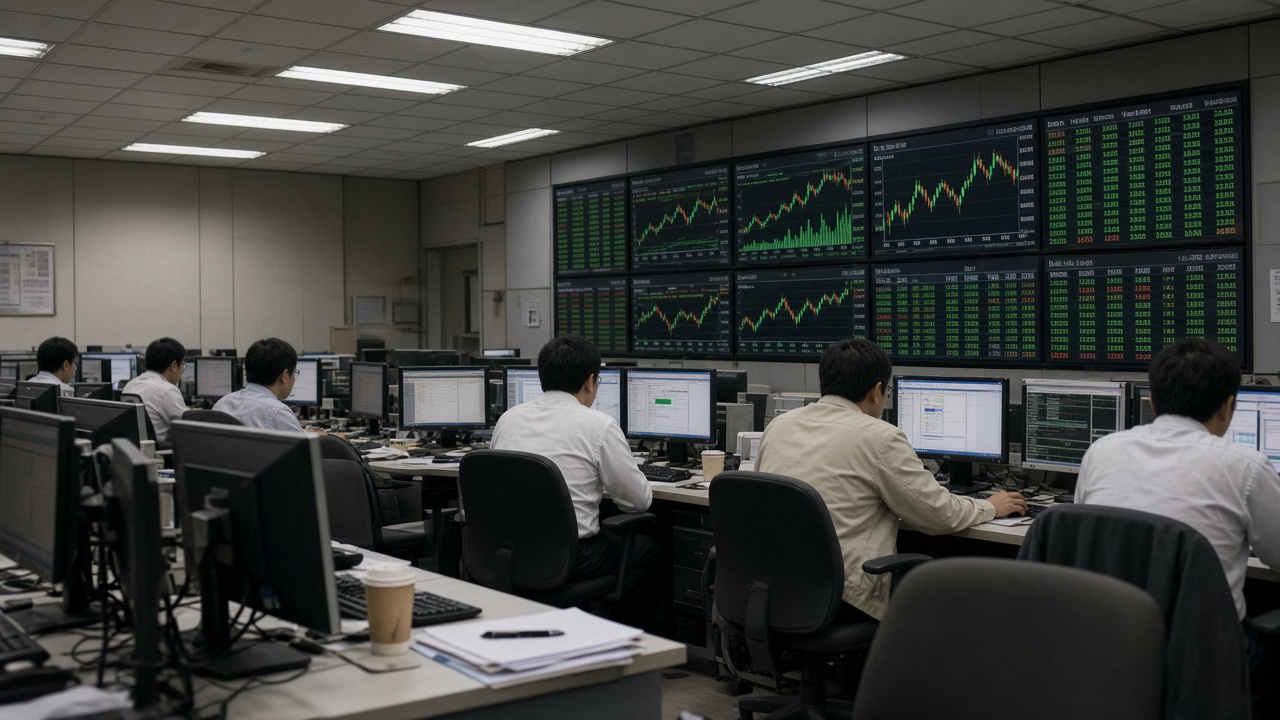
Taiwan’s benchmark TAIEX closed 23.41 points below its record finish on Monday, even as chip-linked heavyweights pushed aggregate turnover past NT$820 billion—the kind of cash velocity usually reserved for policy surprises or global risk-on bursts. The index still ended higher on the day, led by foundry and AI supply-chain names, but the narrow miss of a fresh high captured how crowded the semiconductor long has become heading into a U.S.–China diplomatic week that Taipei traders watch for export-control headlines.
Who led—and by how much
TSMC shares added more than 2% intraday before giving back a slice of the gain into the close, finishing at NT$2,480 according to exchange data. MediaTek, ASE Technology, and substrate vendors traded active lots as foreign institutional investors bought on the opening tick and trimmed into the afternoon. Domestic mutual funds, meanwhile, rotated from financials into semi cap-ex names, a pattern dealers said mirrored September revenue optimism from Hon Hai and equipment orders circulating in Hsinchu.
Market breadth was positive but not euphoric: gainers outnumbered losers roughly three to two on the main board, suggesting the rally was concentrated in liquidity-rich tech rather than a blanket risk bid. Transportation and traditional manufacturing lagged, reflecting fuel cost worries and softer export orders outside the AI complex.
Why turnover crossed NT$820 billion
The Taiwan Stock Exchange’s daily bulletin showed combined main-board and OTC turnover at NT$821.4 billion, the highest print since early summer volatility around U.S. rate expectations. High turnover did not require a blow-out index move; instead, intraday range expansion in top-weight names forced delta hedgers and ETF arbitrage desks to trade more frequently.
Options open interest in weekly calls on TSMC rose into the close, a sign that short-term funds were paying for upside convexity rather than building multi-month positions. Dealers said block trades in the last thirty minutes included a single NT$12 billion package in foundry shares linked to a sovereign wealth fund rebalancing—not a new strategic stake, but enough to lift volume tallies.
The mechanism behind the chip bid
Traders cited three linked stories: AI server demand pulling Taiwan ODM revenue guidance higher, stable advanced-node utilization reported by foundries, and a softer U.S. dollar overnight that made NT-dollar returns on exporters look stronger on paper. None of those factors guarantees next-quarter earnings beats, but they explain why funds that missed the first-half rally were willing to pay up in September.
What would falsify the trade by Friday? A surprise U.S. rule tightening GPU exports, a hawkish Federal Reserve signal that strengthens the dollar, or a TSMC comment on margin pressure during an investor roadshow. The street already embeds high AI expectations; the index’s proximity to a record is as much about positioning as about new information.
How Taipei desks read the near-record
Closing 23 points below a peak is statistically noise, but psychologically sticky for retail investors who track round numbers on mobile apps. Margin lending data from securities firms show modest increases in semi names, not yet at levels associated with past blow-offs. Regulators did not issue cooling warnings Monday, though the Financial Supervisory Commission reiterated disclosure rules for companies commenting on AI order books.
For international investors, the session reinforced Taiwan’s role as the equity proxy for AI hardware cycles. Cash turnover above NT$800 billion tells global desks that liquidity is available to enter or exit large lines without excessive slippage—an underappreciated comfort when geopolitical headlines can gap the market at open. Until the TAIEX prints a clean record close, the question is whether today’s volume was accumulation or the last chase into a crowded quarter.
After-hours futures on the FTSE Taiwan index traded flat, suggesting offshore accounts are not aggressively adding beta overnight. Local life insurers, which must balance duration risk, reportedly sold small futures clips to lock in September gains—a flow that could cap opening momentum Tuesday if U.S. tech earnings disappoint. None of that showed up in Monday’s cash tape, but it frames how quickly a near-record can flip to a pullback when NT$800 billion sessions become routine rather than exceptional.