Shield AI closed an $85 million Series F-2 extension led by returning defense investors, capital the company says will fund Navy-led planning for autonomous carrier landing trials tied to its X-BAT vertical-takeoff jet program. The round is smaller than March’s $1.5 billion Series G but signals that maritime customers want dedicated balance-sheet room for ship-integration engineering without diluting the flagship valuation narrative investors already priced after Hivemind won Air Force collaborative-combat aircraft work.
How the Navy money stacks
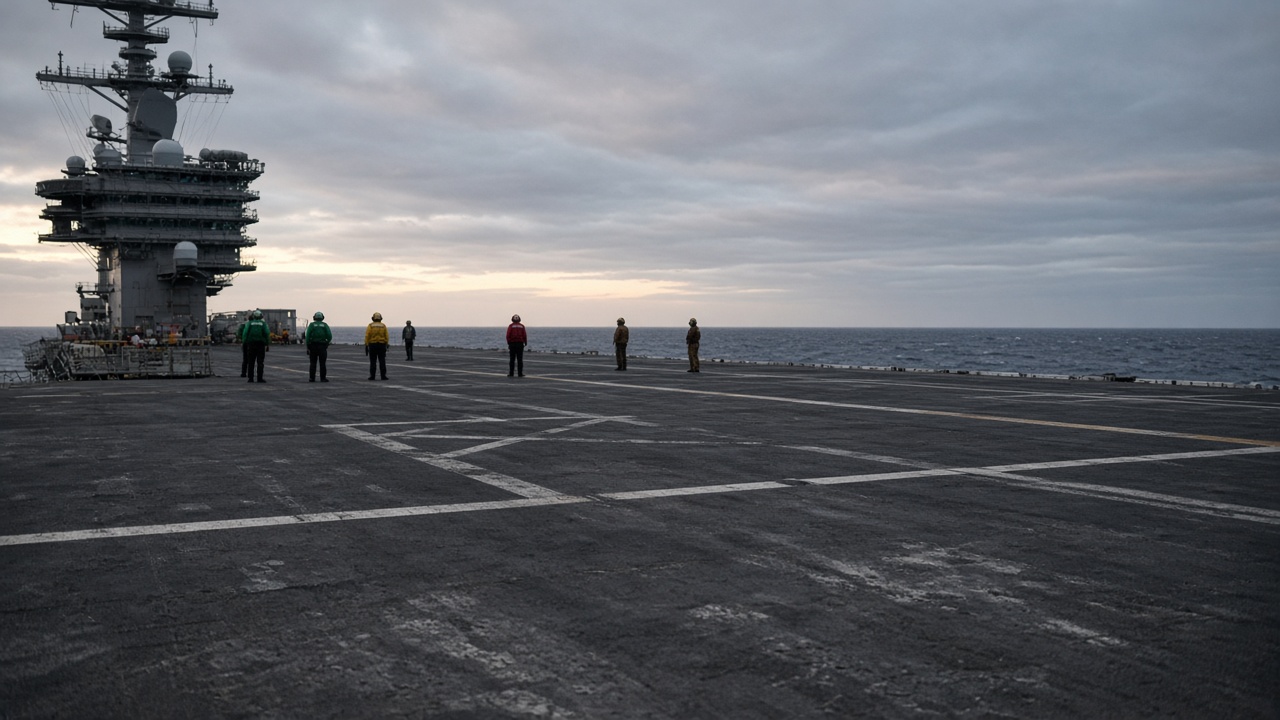
In August the Department of the Navy Rapid Capabilities Office, PAE Aviation, and the Defense Innovation Unit committed $50 million to scale Runway Independent Maritime Expeditionary Strike with X-BAT—a runway-agnostic strike concept meant for destroyers and amphibs as much as supercarriers. Shield’s F-2 extension sits atop that government line, earmarked for deck-handling simulations, catapult-and-recovery interface studies, and autonomy software hardening before any arrested landing attempt.
Company executives have publicly targeted a first X-BAT flight before year-end 2026, with a turbofan derived from the F-16’s F110 engine providing thrust for vertical recovery modes likened to reusable rocket landings. Analysts caution that engine integration and shipboard salt environments routinely slip schedules even when venture slides look confident.
Concept art versus test points
Shield’s Hook conference imagery placed X-BAT on USS Abraham Lincoln beside F-35Cs, a visualization that excited social channels and annoyed program officers who distinguish marketing renders from approved concepts of operations. Army Recognition and trade press noted the graphics do not establish a formal carrier deployment decision—only how the company hopes runway-independent aircraft might someday augment air wings.
Investors still liked the story: carrier trials planning de-risks a marquee use case even if the first demonstrations occur on smaller decks or land-based ski-jump surrogates. The Series F-2 paperwork, according to people familiar with the terms, includes milestones tied to Navy observer sign-offs rather than Instagram engagement.
Why the Air Force is not paying
Shield’s Hivemind autonomy stack is embedded in Air Force collaborative combat aircraft prototyping, including vendor pairings with Anduril’s Fury airframe, but USAF has declined to fund X-BAT itself. Former operators now in industry say the Navy’s vertical-launch problem—getting sensors and weapons airborne from ships without full carrier aviation infrastructure—is a clearer buyer than the Air Force’s crowded CCA budget.
That division lets the Navy treat X-BAT as an experiment financed partly by DIU while Shield’s broader valuation rests on software reuse across V-BAT quadcopters already in production. F-2 dollars are explicitly maritime, not another land-based drone line item dressed as synergy.
Ownership and dilution math
After Series G at a $12.7 billion post-money mark, an $85 million extension is a thin slice for existing backers—Riot Ventures, Snowpoint, and strategic names from prior rounds—who want option value on Navy contracts without reopening full board negotiations. Employees hear less about headline valuation this quarter and more about hiring flight-test engineers in San Diego and Patuxent River liaison staff.
Defense peers Anduril and Saronic continue raising at steeper multiples; Shield’s pitch is proven autonomy software plus a jet-sized airframe bet the Navy is willing to co-fund. If carrier trials slip into 2027, the F-2 tranche buys runway—pun intended—without forcing a down round narrative while Middle East tensions keep autonomy budgets politically sticky.
What to watch on the deck
Look for contract modifications naming specific carriers, shore-based arrested-landing test fixtures, or DIU evaluation memos—not renderings. Until the first X-BAT vertical landing is on video with Navy observers in frame, treat carrier integration as a funded planning exercise. The Series F-2 close means Shield’s investors are paying to keep that exercise on the calendar.
Industrial base knock-on effects
Suppliers of carrier-grade tie-down gear and jet-blast deflectors report unsolicited inquiries from Shield’s integration team, even though no flight-test contract has hit the Federal Register yet. That early supply-chain chatter is how defense unicorns signal seriousness to the Pentagon without publishing classified annexes—vendors get NDAs, investors get term sheets, and sailors still wait for proof on deck.