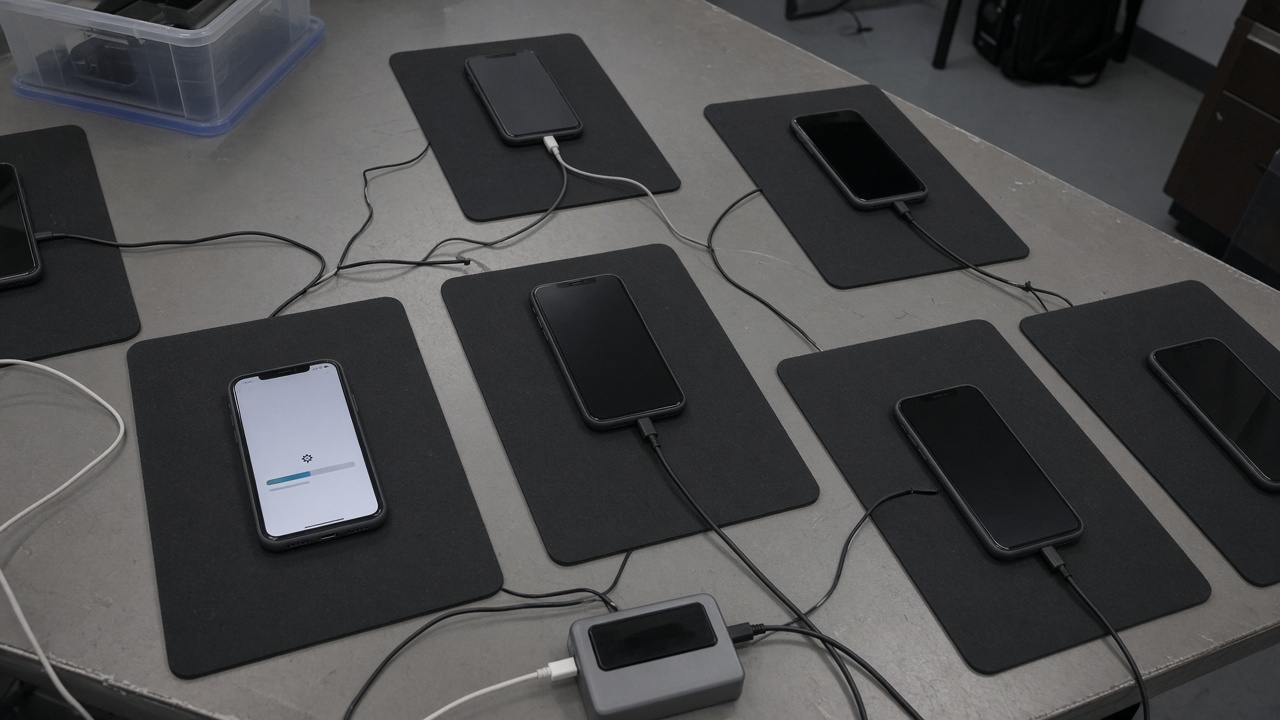
Enterprise mobility teams spent the weekend pushing Apple’s iOS 26.7 security update to supervised iPhones and iPads after independent researchers published a proof-of-concept that chains a sandbox escape into kernel code execution. Apple fixed the underlying race condition in its September 14 coordinated release, alongside the larger iOS 27 branch, but many U.S. fleets deliberately stayed on iOS 26 while they retested line-of-business apps, carrier profiles, and peripheral drivers. For those organizations, 26.7 is the patch that closes the gap without forcing a major OS migration during a Fed-hike quarter when hardware refresh budgets are already frozen.
What triggered the rush
The flaw, tracked as CVE-2026-84607, carries a 7.8 severity score in public databases. Apple’s advisory language is blunt: a sandboxed application may execute arbitrary code with kernel privileges. STAR Labs SG and Nebula Security are credited in Apple’s IOGPUFamily entry on the 26.7 bulletin, reflecting how quickly proof-of-concept material moved from lab benches to GitHub-adjacent disclosure threads that CISO mailing lists monitor.
Apple has not marked the issue as exploited in the wild, and it does not appear on CISA’s known-exploited catalog. That distinction matters for risk committees, but it rarely slows MDM operators who remember last decade’s zero-day markets. The practical trigger was reproducibility: enough detail circulated that internal red teams could validate the chain on loaner hardware before Monday’s change windows opened.
How MDM fleets are staging the build
Large supervised estates typically run a three-phase pattern: pilot rings of executives and IT staff, a broader employee cohort, then stubborn devices on deferral policies. Commands flow through Apple Business Manager assignments—required updates, single-app mode exits, and reboot nag intervals tightened from weekly to daily. Inventory exports from Jamf, Intune, and Workspace ONE feed compliance dashboards that flag any handset still reporting a vulnerable build.
Operators report a familiar friction point: version strings on the device occasionally disagree with MDM inventory after major September releases, a reporting mismatch security bloggers documented during the iOS 27 rollout. Teams are cross-checking Settings → General → About against management server records before they close audit tickets, because a green compliance tile that lies about the kernel build is worse than a delayed patch.
Why many shops stayed on iOS 26
iOS 27 remediates more than a hundred additional issues, including roughly twenty kernel flaws on Apple’s own count for that branch. Financial services and health systems that certified mobile apps on iOS 26 this summer are treating 27 as a separate program with regression suites, not a silent Tuesday update. Apple’s parallel 26.7 track exists precisely for that audience: security backports without UI churn.
Peripheral ecosystems add delay. Little Snitch and Objective-See BlockBlock required explicit version bumps before macOS 27 upgrades on sibling Mac fleets; mobile teams worry about VPN clients, smart-card middleware, and custom camera SDKs that lag dot releases. Holding 26 while patching 26.7 is the compromise between exposure time and help-desk load.
What security officers want documented
Internal memos this week ask application owners to confirm that no sideloaded or developer-signed builds remain on field tablets, because the attack model starts in a sandboxed app store binary. Legal and HR devices with relaxed app policies get re-scanned first. Backup strategies shift too: encrypted backups before forced updates, in case a banking app’s local cache corrupts during reboot loops that MDM sometimes triggers on low storage devices.
For boards, the talking point is operational resilience, not panic. The September cycle was already the largest single Apple patch batch on record—hundreds of CVEs across phone, desktop, and living-room OS lines. Staying current on the branch you certified is the job; pretending every phone can jump to 27 overnight is not.
What to watch next
Apple’s next security-response notes will show whether researchers pivot from GPU-family bugs to other kernel surfaces named in the 27 bulletin. MDM vendors will ship dashboard widgets that highlight CVE-2026-84607 exposure specifically, the way they did for prior WebKit chains. Until iOS 27 qualification finishes, 26.7 is the enterprise floor—and the proof-of-concept ensures no one treats that floor as optional.