Hon Hai Precision Industry lifted its September consolidated revenue guidance on Monday after customs brokers in Taoyuan reported a faster-than-planned release of AI server racks bound for U.S. and European data-center customers. The revision does not change full-year capital spending, but it tells investors which product line is dictating cash conversion inside the world’s largest electronics assembler: cloud and networking, not the iPhone lines that still absorb thousands of shop-floor hours in Zhengzhou and southern Taiwan.
What the company filed—and what it left out
In a Taiwan Stock Exchange filing after the close, Hon Hai said it now expects September consolidated revenue to land near the upper half of the range it gave investors on Sept. 5, when August sales already printed at NT$921.8 billion on a 52% year-on-year jump. Management attributed the tweak to “accelerated customs clearance” for rack-level AI infrastructure at Taoyuan, not to a sudden consumer-electronics rebound. The statement repeated earlier caution on currency: the New Taiwan dollar’s firmness against the U.S. dollar continues to shrink translated dollar sales even when shipment volumes rise.
The filing’s tone matches what contract manufacturers have said all quarter: hyperscalers are pulling forward rack deliveries ahead of year-end cluster buildouts, while smartphone builds stay flat. Hon Hai did not break out rack units in the filing, and it did not update fourth-quarter margin guidance. Analysts who track monthly revenue will still wait for the Nov. 12 earnings call for gross-margin detail on power and cooling subassemblies, where competition from smaller ODMs has intensified.
Taoyuan customs as the choke point
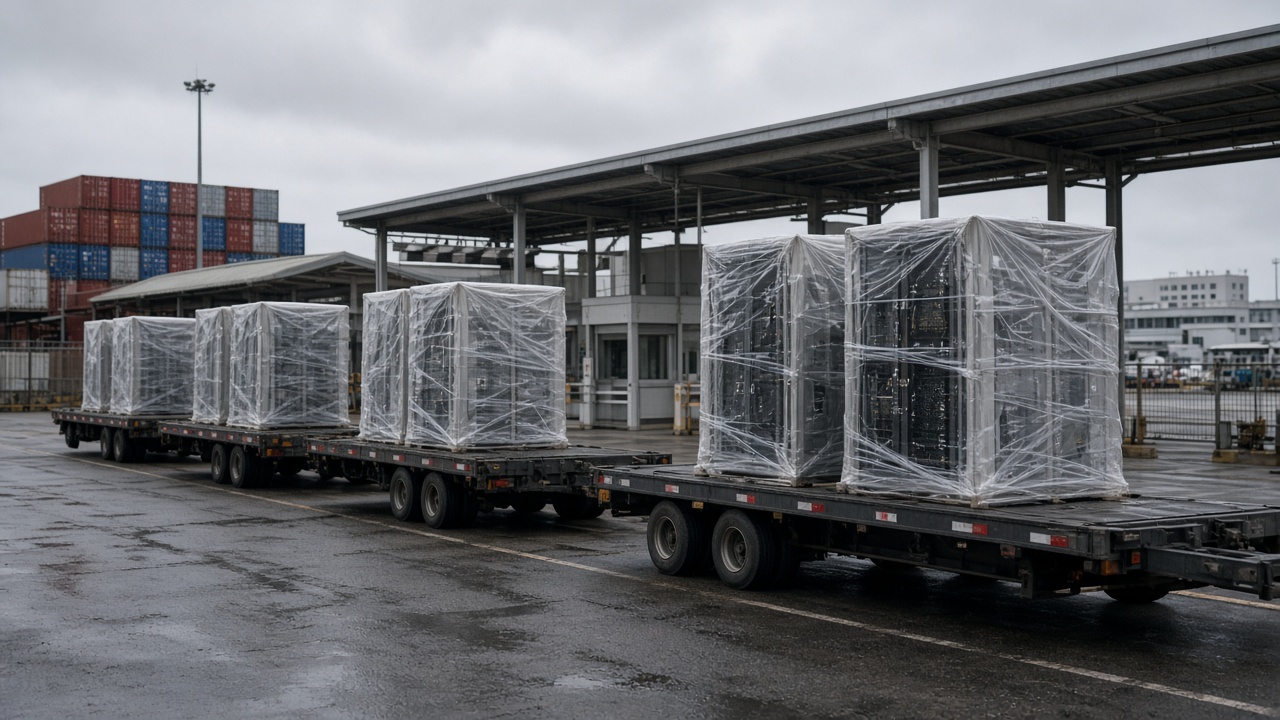
Brokers and freight forwarders at Taoyuan describe September as a contest between belly-hold electronics and dedicated freighters carrying finished racks. Taiwan Customs data show elevated declarations for high-value server equipment under harmonized codes used for data-center gear, with inspection teams scheduling overtime shifts through the Mid-Autumn holiday week. One forwarder said racks that sat in bonded yards for five days in August were averaging three days in September after Hon Hai pre-filed component manifests and aligned serial numbers with U.S. end-user import licenses.
That operational gain matters because racks are bulky, high declared-value shipments where a day of delay ties up letters of credit and warehouse space near the airport’s cargo terminals. Hon Hai operates consolidation sites in Taoyuan and Linkou; traders said trucks were leaving for Taipei port only when ocean charters for backup capacity required it, with most racks still flying out on combination passenger-cargo rotations or integrator freighters.
Inside the cloud-and-networking bet
Hon Hai’s monthly disclosures no longer read like an Apple proxy. Cloud and networking revenue has outgrown consumer electronics in recent quarters, reflecting Nvidia server partnerships and European assembly deals that route subassemblies through Czech plants before final integration in France. September’s guidance lift reinforces that mix shift: investors who model Hon Hai as a handset margin story are misreading the order book.
Employees in Taoyuan component parks said weekend shifts stayed optional for phone lines but mandatory for rack cable harness teams—a scheduling detail that rarely appears in investor slides but shows up in overtime payroll. Union representatives in New Taipei noted that safety briefings for heavy-lift rigging increased as rack weights rose with denser GPU trays.
What could slow the fourth quarter
Management kept its geopolitical warnings in place. U.S. tariff rhetoric on semiconductors and finished servers, plus any surprise export-control tweak on advanced GPUs, could pause shipments even after customs release. Currency remains the other swing factor: every one-percent move in the NT dollar against the dollar shows up quickly in Hon Hai’s translated reports, even when rack volumes hold steady.
For Taiwan’s broader supply chain, Hon Hai’s September revision is a demand thermometer. Component vendors from power-supply makers to sheet-metal shops watch Hon Hai’s monthly number as a proxy for AI capital spending. If October customs throughput matches September’s pace, the bottleneck moves from Taoyuan yards to U.S. site power hookups—not from Hon Hai’s assembly floors.